
Warning! Stock Exchange Opens Tomorrow, IHSG Surrounded by US Data and Escalating War
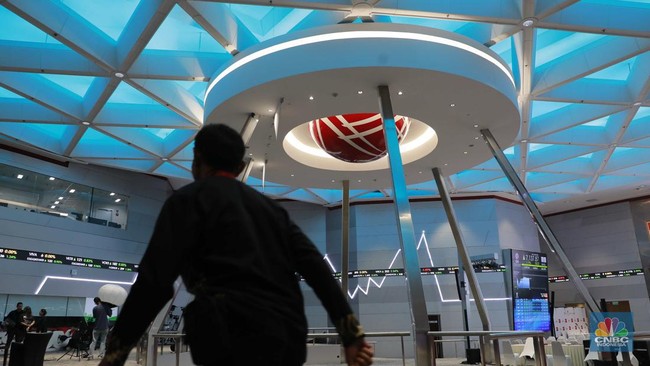
The Indonesian stock exchange will reopen tomorrow, Wednesday (25/3/2026). Market participants will once again scrutinise several important sentiments for the remainder of this week’s trading, after the domestic financial markets were closed on Monday and Tuesday, 23-24 March 2026, for joint leave and post-Eid holidays. Although this week is shorter, investor attention remains focused on various key global and domestic agendas. These range from developments in circulating money, US consumer sentiment data, the release of US import and export prices, to initial US unemployment claims, which will provide the latest picture of labour market conditions in Uncle Sam’s country. This series of sentiments is expected to act as catalysts driving the market, from stocks and the rupiah exchange rate to commodity prices throughout this week’s trading. War Developments The war between Iran and Israel and the US remains heated. The intensification of the war will have a significant impact on Indonesian stock movements. Quoted from Reuters, Iran launched several waves of missile attacks on Israel, according to the Israeli military, after US President Donald Trump postponed plans to bomb Iranian power plants and energy infrastructure due to what he called productive talks with Iranian officials. Those missiles triggered air raid sirens in several areas of Israel, including Tel Aviv, where explosions from the interception system were heard. In one attack, homes in northern Israel were damaged by falling debris after a missile was successfully intercepted. There were no reports of casualties. Trump wrote on the Truth Social platform on Monday that the US and Iran had held “very good and productive” talks regarding a “full and total resolution of hostilities in the Middle East.” As a result, Trump said he was postponing for five days the plan to attack Iran’s power plants, which he had previously threatened if Iran did not reopen the Strait of Hormuz. However, this postponement only applies to Iranian energy facilities, while US attacks on the country continue, according to a report by US media Semafor citing a US official. Iran has effectively closed that vital strait—a route for around 20% of the world’s oil and liquefied natural gas (LNG)—since the US and Israel launched the war on 28 February. More than 2,000 people have died in the conflict. Iran responded to the threat by stating it would attack US allies’ infrastructure in the Middle East, increasing the risk of extreme disruptions to global energy supplies. Trump’s step back briefly drove up US stock prices and a sharp drop in oil prices below US$100 per barrel, reversing market pressures from weekend threats and Iran’s promise of retaliation. However, that rise was threatened on Tuesday after Iran’s Parliament Speaker Mohammad Baqer Qalibaf—who was cited as an intermediary in the talks by Israeli officials and other sources—said no negotiations had taken place. “There are no negotiations with the US, and fake news is being used to manipulate financial and oil markets and escape the difficult situation faced by the US and Israel,” he wrote on the X platform. Iran’s Revolutionary Guard Corps (IRGC) stated they had launched new attacks on US targets, and called Trump’s statements an “outdated psychological operation” that has no effect on Tehran’s struggle. On Tuesday, US bond yields rose and the dollar strengthened again, as the world still faces energy shocks due to Iran’s threats to shipping routes in the strait. Circulating Money From domestically, market participants will await the release of circulating money developments scheduled to be announced by Bank Indonesia on Friday (27/3/2026). This data is important to gauge liquidity conditions in the economy, especially after the previous period showed fairly high growth. In the latest release, Bank Indonesia reported that broad money supply (M2) in January 2026 grew 10.0% year-on-year, higher than the 9.6% year-on-year growth in December 2025. The M2 value in January 2026 reached Rp10,117.8 trillion, with growth supported by narrow money (M1) rising 14.9% and quasi-money growing 5.4%. Therefore, the February 2026 release will be monitored to see if liquidity growth continues, slows, or strengthens further. The direction of circulating money is also usually watched by the market as it can provide an early indication of domestic demand, credit conditions, and room for future economic activity. US Consumer Confidence From the United States, the market will await the final release of the March consumer sentiment index from the University of Michigan on Friday US time. The institution has scheduled the final March 2026 release for Friday, 27 March 2026, at 10:00 a.m. local time. In the preliminary reading, the consumer sentiment index fell to 55.5 in March 2026 from 56.6 in February. This decline indicates that US households are becoming more cautious, amid growing concerns about economic conditions and energy price pressures. The Michigan preliminary survey also showed weakening mainly in the expectations component, which fell to 54.1 from 56.6. This week’s final data will be of interest because it can signal how much the surge in petrol prices and global uncertainty are pressuring US consumer confidence. If consumer sentiment weakens further, the market may assess that American household spending resilience is beginning to face greater pressures. US Import-Export Prices Signal Inflation Pressure Another sentiment to be monitored comes from US import and export price data for February 2026, scheduled for release on Wednesday (25/3/2026) at 08:30 US time. This will be announced by the Bureau of Labor Statistics (BLS). As a comparison, in the previous release