
War at the Negotiating Table
Joko Sembung rides the tram,
Not connecting to Trump’s direction.
If there were a competition for the most diplomatic statement that feels like an evasion, the trophy would probably be delivered straight to the White House that day without needing judges. The evasion is like the pantun above.
Precisely on the fortieth day of the war, United States President Donald Trump delivered something that, if read slowly, feels like an announcement of victory slipped into the language of defeat.
Of course, the phrase “we lost” never appeared. How could a country as vast as America, which is not alone but ganging up with Israel, suddenly admit to being subdued by Iran standing solo?
It’s like a giant slipping on a banana peel, then saying: “I intentionally fell to test gravity.”
However, as often happens in global politics, reality does not always reside within the official text. It often leaks from the gaps in the narrative.
In his official statement, Trump constructed a narrative that sounds neat, almost like a report of success wrapped in caution.
He stated that the decision to halt attacks for two weeks was taken after communication with Pakistan’s Prime Minister Shehbaz Sharif and Army Chief Asim Munir.
He seemed to want to emphasise that the step was not a retreat, but the result of strategic coordination.
Trump also stressed that America had “achieved and even exceeded” all its military targets.
That is a sentence that sounds bold, though it precisely invites questions: if all targets have been achieved, why the pause for negotiations?
He then mentioned a ten-point proposal from Iran deemed “workable” as the basis for talks, while implying that nearly all long-standing dispute points have found common ground.
In this frame, the two-week pause is positioned not as pressure, but as space for finalisation towards long-term peace in the Middle East.
That is Trump’s narrative which, if read at a glance, feels like a diplomatic victory, but if pondered longer, leaves an echo of unanswered questions.
Iran responded to the statement with a far more detailed version, almost like opening “footnotes” deliberately hidden.
From Tehran’s perspective, what is called a “two-week ceasefire” is not a war pause in the sense of peace, but a negotiation pause.
That pause becomes breathing room to formulate agreement details, after the opposing side—in this case America—accepted the basic principles proposed by Iran.
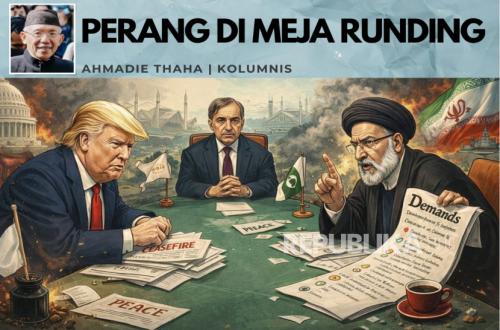
This is where the stage becomes intriguing. The negotiations are not taking place in Washington, nor in Tehran, but in Islamabad. And the matchmaker is not an old-school Western diplomat, but Pakistan’s Prime Minister Shehbaz Sharif.
In its official speech, Iran’s Supreme National Security Council spoke not in a tone of doubt, but with confidence almost resembling a delayed victory declaration.
They described the 40-day war as a phase that has brought the enemy to a deadlock, even forcing the opponent to seek an exit through diplomatic channels.
In Tehran’s narrative, the decision to enter the negotiating table is not a form of fatigue, but a continuation of battlefield victory that wants to be “locked in” as a political win.
They emphasised that the two-week pause is not the end of the war, but part of a longer strategy.
At that point, every agreement detail must submit to the ten principles they proposed, from lifting sanctions to withdrawing foreign troops from the region.
With a firm yet cold tone, Iran also reminded that these negotiations are taking place in an atmosphere of full distrust, and that their hand remains on the trigger.
They are ready to return to the field if the opponent deviates even slightly from the agreement.
Thus is Iran’s speech which, instead of closing the war, actually emphasises that the battle has merely shifted arenas, from the thunder of weapons to diplomatic tension.
The world suddenly feels like a geopolitical soap opera: two sides that hammered each other for 40 days, now willing to sit face-to-face, accompanied by a “peacemaker” who was previously not much in the spotlight.
Pakistan, which has so far more often been a field of influence tug-of-war, suddenly rises in class to become a historic facilitator.