
Trade Ministry Identifies Root Cause of Bulog's Difficulty in Distributing Minyakita Cooking Oil
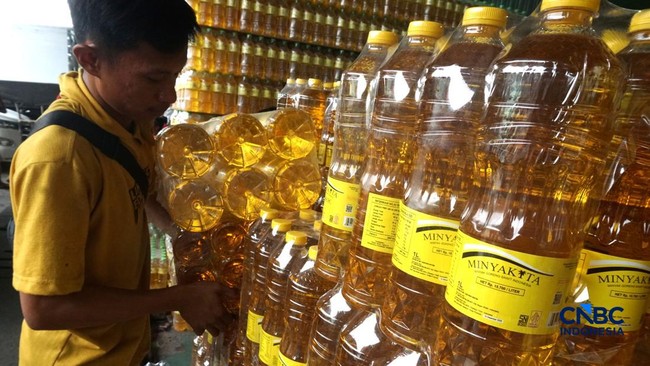
The Trade Ministry (Kemendag) has disclosed obstacles in distributing people’s cooking oil, or Minyakita, to retail traders in markets. Perum Bulog is reported to be facing difficulties in distributing the commodity because several traders do not yet possess a Business Identification Number (Nomor Induk Berusaha/NIB) as required by regulations.
The Trade Ministry’s Director of Domestic Market Development, Nawandaru Dwi Putra, stated that the concerns were raised directly by Bulog during a cooking oil distribution coordination forum.
“I also heard several submissions yesterday, one of which involved an obstacle raised by Perum Bulog. In this forum, we also conveyed that in several locations, in several regions within Bulog’s Regional and Branch Offices, there are also difficulties in distributing Minyakita to markets, particularly to retail traders,” said Nawandaru at the Regional Inflation Control Coordination Meeting on Monday (16 March 2026).
“Indeed, under the Trade Ministry regulation, retailers are required to maintain business entities or business permits, namely NIB,” he added.
He assessed that to address the issue, the Trade Ministry had sent a circular to all regions to encourage regional trade offices and Bulog to assist traders in the NIB registration process.
“To bridge the aforementioned obstacles, we have already sent a circular from the Director General of Domestic Trade to all regions to assist and encourage support and facilitation in order to promote the acquisition of Business Identification Numbers,” he explained.
The Trade Ministry also requested that Bulog’s partners located outside markets be encouraged to enter public markets so that distribution does not disrupt market supply balance.
“If there is more supply from Bulog to retail traders outside markets or Perum Bulog’s partners, this will also distract supply in the market,” said Nawandaru.
On the other hand, he assessed that NIB registration for small traders is actually quite straightforward because there are facilities for micro enterprises.
“Because in reality, NIB registration for traders at the micro and small enterprise level does have facilitation. This is merely a matter of lack of awareness,” he said.
Meanwhile, the Trade Ministry confirmed that the realisation of the domestic market obligation (DMO) for cooking oil by state-owned food enterprises still exceeds the government target.
“For the realisation of DMO to D1, particularly state-owned enterprises, it has been recorded since the Trade Ministry Regulation 43/2025 came into effect at 42%. This means it is already above target, which is a minimum of 35%,” revealed Nawandaru.
Nevertheless, he acknowledged that at the beginning of the year, distribution was slightly pressured because producers and state enterprises were still adapting to the business-to-business (B2B) cooperation scheme.
He also stated that approximately 75% of producers have met the minimum DMO distribution requirement of 35%. The government hopes the remaining producers will follow suit by March 2026.
“We also report that approximately 75% of producers have already met the minimum 35% threshold requirement, and we hope that the remaining 25% of producers will also follow quickly in March,” he said.
According to him, various distribution obstacles that have emerged in the field are now being gradually addressed through coordination between producers, state-owned food enterprises, and regional governments.