
The World is Getting More Chaotic! New Conflicts Looming, This Could Be the Outcome
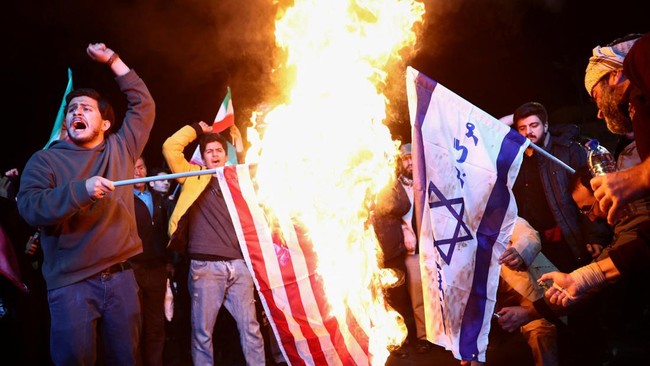
The war involving the United States (US) and Israel against Iran is not truly over. Although its intensity has subsided, its impacts are already widespread, not only in the Middle East but also on the global order.
Political scientist Georgy Asatryan describes this conflict as a turning point that accelerates the world’s shift from a unipolar to a multipolar system.
“Tehran’s resistance is accelerating the inevitable shift towards multipolarity,” he writes, as quoted by RT on Thursday (16/4/2026).
He assesses that the military steps taken by Washington are actually contributing to weakening the global system that the US itself has built. The initial hope that Iran would quickly collapse under military pressure did not materialise.
On the contrary, Iran has shown significant resilience. Despite suffering major losses, including in its leadership ranks, Tehran has been able to adapt, absorb the initial pressure, and begin shaping the conflict according to its own interests.
“Tehran did not surrender. They absorbed the initial blows and began shaping the conflict according to their interests,” Asatryan explains. Indeed, Iran’s Revolutionary Guard Corps is assessed as capable of challenging US military operational dominance in several sectors.
The impact of this conflict extends far beyond the battlefield. One of the most crucial developments is the blockade of the Strait of Hormuz, a vital route for global energy distribution.
This move forces major countries to face direct risks in the form of supply disruptions and rising energy prices. Several countries have reacted swiftly, including India, which has held emergency discussions on national energy security.
According to Asatryan, Iran’s strategy has successfully expanded the conflict’s pressure beyond the region. In the long term, this situation is seen as pushing the world into a phase of more intense militarisation. Countries are now increasingly bold in acting unilaterally, with military power more frequently used as a policy instrument.
“The result is a more turbulent world, where military power becomes a routine policy instrument,” he writes. He also highlights the fading of the deterrence concept that previously formed the foundation of global stability, replaced by growing impunity among countries.
Tensions are now spreading to various regions. The Afghanistan-Pakistan border is experiencing increased clashes and cross-border attacks, while rivalry between India and Pakistan is heating up again. With both countries possessing nuclear weapons, even limited conflicts are seen as carrying global implications.
“Even limited conflicts in this region carry global implications,” he states.
Beyond that, several other areas from South Asia to the Caribbean are beginning to show signs of new tensions. This phenomenon is viewed as part of a broader pattern, where the weakening of global rules opens greater space for conflict escalation.
Asatryan assesses that the world is now moving towards fragmentation, with increasingly fragile alliances and rules that are losing their binding power. The Hormuz blockade, Iran’s resilience, and the US’s failure to achieve a quick victory serve as indicators of changing global power balances.
“Even middle-tier countries can now challenge great powers and force them into strategic stalemates,” he says.
He warns that the most dangerous lesson from this conflict is the emergence of the belief that military power can be used without major consequences. As this view spreads, the risk of new conflicts increases.
“The next conflict is no longer a question of whether it will happen, but where,” he concludes. According to him, in an increasingly uncertain global situation, new escalations are assessed as potentially emerging faster than expected.