
Strengthening Synergy, BI Launches Inflation Control Movement in East Java
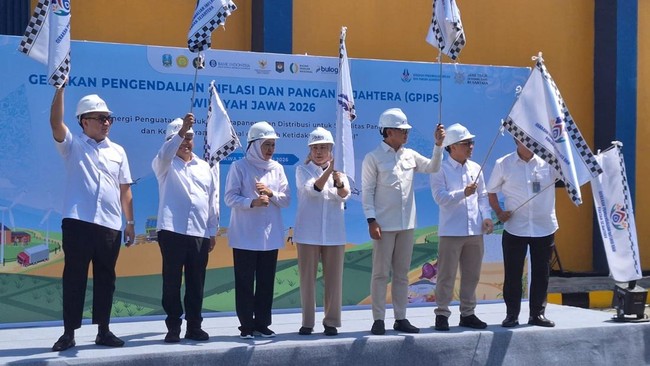
Bank Indonesia (BI), together with the Central Inflation Control Team (TPIP) and the Regional Inflation Control Team (TPID), officially launched the Food Prosperity Inflation Control Movement (GPIPS) in East Java today, Wednesday (13/5). GPIPS 2026 carries the theme “Synergy in Strengthening Production, Post-Harvest, and Distribution for Food Stability and National Welfare Amid Global Uncertainties.”
Bank Indonesia Deputy Governor Aida S. Budiman stated that GPIPS represents an evolution of the National Food Inflation Control Movement (GNPIP). This refinement is driven by the increasingly complex challenges in price stability and food resilience, necessitating stronger synergy and more integrated programme implementation from upstream to downstream.
“Through GPIPS, food inflation control is not only focused on short-term price stabilisation but also on strengthening food production, post-harvest handling, and distribution to support sustainable national food resilience,” Aida explained during the GPIPS launch in East Java on Wednesday (13/5/2026).
She explained that East Java was chosen due to its strategic role in the national food resilience map. 2025 production data shows East Java’s dominance in nearly all major food commodities, namely rice, corn, cayenne pepper, and shallots.
In addition, East Java is the largest rice producer with a contribution of 17.34% of national production, with a total output reaching 10.57 million tonnes.
“This dominance is also reflected in East Java being the number one producer of corn and cayenne pepper, while shallot production ranks second highest nationally. This superiority positions East Java as the backbone of the government’s 2026 priority programmes in achieving rice and corn self-sufficiency,” Aida clarified.
Beyond production capacity, East Java holds a strategic position as a trade hub for eastern Indonesia, known in the national connectivity map as the New Nusantara Gateway. Through Tanjung Perak Port, East Java serves as the main distribution node connecting food logistics flows from Java to various regions in Sulawesi, Nusa Tenggara, Maluku, and Papua.
“This geographical position makes East Java not only a food barn but also a gateway for food distribution to millions of residents in eastern Indonesia. This is a highly relevant role in strengthening Inter-Regional Cooperation (KAD) across regions,” Aida elaborated.
Furthermore, the presence of Bulog storage in East Java strengthens the province’s role in the national food resilience chain. Bulog’s warehouse capacity in East Java reaches 1.22 million tonnes, equivalent to 22.81% of the national warehouse capacity. This figure reflects the significant role of East Java in managing the country’s food reserves.
“Dominance in production, position as a distribution gateway for the eastern region, and storage infrastructure capacity are three factors that make East Java Province the appropriate and symbolic choice for the Grand Launching of GPIPS Java,” Aida stated.
On the same occasion, East Java Governor Khofifah Indar Parawansa appreciated BI’s step in launching the GPIPS movement in East Java.
“Thank you for launching GPIPS here in East Java, so that food prosperity can truly be realised and its benefits felt by the wider community throughout Indonesia,” Khofifah said.
She outlined that the East Java region has Inflation Control Showcases (EPI) both at the district and city levels. These showcases are part of strengthening inter-regional cooperation for mutual price control mitigation.
“We often communicate that connectivity between markets in districts and cities, and inter-regional cooperation, is something we are still actively pursuing,” she explained.