
Social Affairs Minister Pushes Updating of DTSEN for Accurate Welfare Targeting and Empowerment
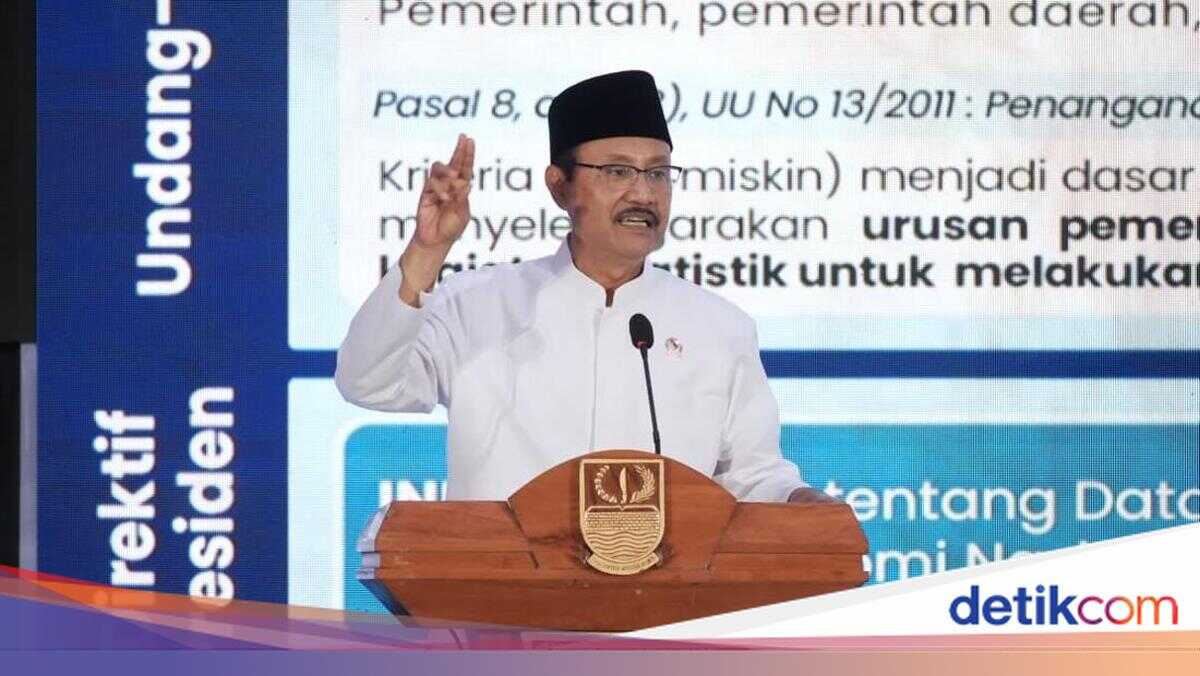
Social Affairs Minister Saifullah Yusuf (Gus Ipul) has said that updating the National Social Economic Single Data (DTSEN) is a crucial step to ensure social assistance and community empowerment programmes are properly targeted.
Gus Ipul made the remarks at the event ‘Collaboration of the President’s Priority Programs in Building Human Resources Towards Economic Independence’ at the Swatantra Wibawa Mukti Building in Bekasi Regency.
“I hope that with data that is increasingly accurate and real-time, it will not only ensure that the assistance is properly targeted but will also empower communities,” Gus Ipul said in a written statement on Wednesday, 4 March 2026.
Gus Ipul stressed that data quality is a decisive factor in the effectiveness of government policy. With accurate data, various social welfare and empowerment programmes will be effective and well targeted.
Updating DTSEN is a follow-up to Presidential Instruction (Inpres) No. 4/2025, which mandates central and regional governments to coordinate and collaborate with BPS to update DTSEN.
On this occasion, Gus Ipul praised Bekasi Regency’s readiness to support the DTSEN updating process, from providing human resources to workspace facilities for village data operators.
“Bekasi has prepared everything related to this updating exercise. From human resources, village data operators, to devices such as laptops that support the work of village operators,” Gus Ipul said.
Gus Ipul described the Regency’s attention as a strategic step to boost the professionalism of operators in updating DTSEN.
“It is not possible for everything to be perfect. But at least the measured supports are very strategic in making village operators work more professionally,” he said.
As a form of support, Acting Bekasi Regent Asep Surya Atmaja said the Bekasi Regency government provides support to SIKS-NG operators in the form of soft financial assistance.
“They will receive Rp 500,000 per month, paid quarterly. In the third quarter we will add one laptop per village,” he said.
According to Asep, differences in village population sizes are among the challenges in data management. Therefore, larger villages are likely to receive additional data operators to optimise the updating process.
Also in attendance were Wardatul Asriah, a member of Commission VIII of the DPR RI, along with senior officials, the Minister’s Special Staff, and other high-ranking officials from the Ministry of Social Affairs.
The event was also attended by Bekasi Regency DPRD Chair Ade Sukron, Bekasi Police Chief Kombes Pol. Sumarni, Dandim 0509 Letkol Inf. Michael Ronald, Bekasi District Court Chief Faisal Akbaruddin Taqwa, and the State Prosecutor of Bekasi Semeru. The event was also attended by district heads, village chiefs, village data operators, and social pillars across Bekasi Regency.
For information, DTSEN is a database that depicts the socioeconomic conditions of every individual and family in Indonesia. The data is matched with population data and updated periodically to maintain policy targeting accuracy.
DTSEN was formed by merging Regsosek, the Integrated Social Welfare Data (DTKS), and the Data for Targeting Acceleration of Extreme Poverty Eradication (P3KE). The integration makes DTSEN the main reference for national social assistance.
As of January 2026, DTSEN contains 289,060,513 individual records. All data are grouped into 10 welfare deciles, from decile 1 (prasejahtera) to decile 10 (prosperous).
This classification helps the government set priorities more accurately, ensuring social assistance reaches those in need while also promoting autonomy for empowered groups.
To facilitate updates, the Ministry of Social Affairs opens two channels for public participation in updating DTSEN: a formal channel and a participatory channel.
In the formal channel, communities can coordinate with RT/RW to submit data updates via the SIKS-NG operators at the village, kelurahan, or Social Service Office.
These proposals are discussed in village or kelurahan deliberations, followed by ground checks (on-field verifications) by PKH facilitators and the Social Service. The data are then formalised by the regional head.
Meanwhile, the participatory channel allows the public to participate directly via the Cek Bansos app, by reporting to PKH programme assistants, the Command Center service 021-171, and the WhatsApp service 08877-171-171.
All proposals from both channels will be verified by BPS for re-ranking and updated quarterly.