
SBM ITB Develops Village Entrepreneurship Empowerment Model Based on Circular Economy
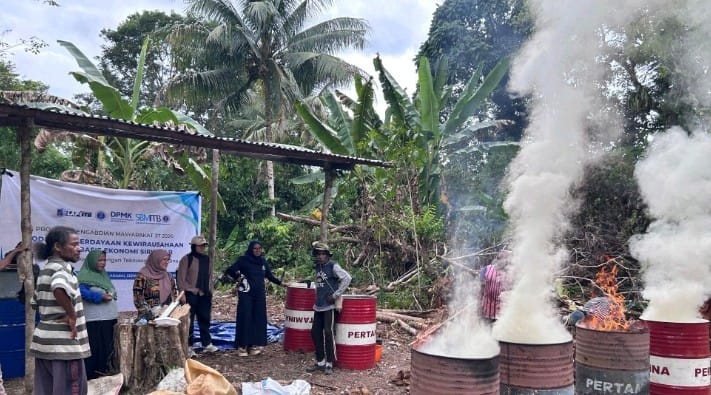
The School of Business and Management (SBM) ITB, through its 3T Community Service Programme 2026, has organised an activity titled “Village Entrepreneurship Empowerment Model Based on Circular Economy: Coconut Shell Charcoal Production with Appropriate Technology” in Adabai Village, Seram Bagian Timur District, Maluku.
The programme, which has run for several months, forms part of SBM ITB’s efforts to promote village economic empowerment based on local potential using a circular economy approach. The activities were implemented in two main phases: training and workshops, and practical production experience in processing charcoal from coconut shells.
Evy Rachmawati Chaldun, head of the community service team and SBM ITB lecturer, explained that Adabai Village possesses abundant coconut potential that has not yet been fully optimised within the economic value chain.
“We want to encourage the community not only to sell coconuts in raw form, but to process shell waste into economically valuable charcoal. This is not merely about production, but about building a sustainable village business model,” she stated.
The activities focused on entrepreneurship workshops and strengthening business management capacity. The sessions featured speakers from various institutions.
R.A. Aisah Asnawi from the Faculty of Economics and Business at Pattimura University provided perspectives on developing local potential-based entrepreneurship in Maluku. She emphasised the importance of forming business groups to enable more structured governance in managing coconut charcoal businesses as a foundation for shared enterprise sustainability.
“The success of village businesses depends not only on production, but also on solid teamwork systems,” she explained.
Listiyah provided training on the coconut charcoal burning process, from selecting suitable shells to producing quality charcoal.
Subsequently, production management material for coconut charcoal was presented by Evy Rachmawati Chaldun, who outlined technical production aspects, burning process efficiency, and the importance of maintaining quality standards so that products can compete in wider markets.
According to Evy, this practical approach is important so that communities understand not only the theory but can implement production processes independently. “This direct mentoring aims to give communities genuine confidence in starting a business. The model is designed to be simple, affordable, and replicable,” she said.
Meanwhile, Desy Kharohmayani discussed business financial management and the application of circular economy principles in the coconut charcoal business model. She explained how waste can be processed again into revenue sources and how to keep financial records.
The workshop, held on 6 February 2026, was conducted interactively with active discussion between participants and speakers. Village residents, youth leaders, and local business operators demonstrated strong enthusiasm towards the material, which was deemed relevant to local economic needs.
In this activity, in addition to lecturers, SBM ITB undergraduate and postgraduate students were involved in the entire community service programme.
The activity continued with direct practical experience in coconut charcoal production using appropriate technology. Participants were introduced to the process of burning coconut shells using a modified drum as a simple yet effective production tool. White smoke billowing from the burning drum illustrated the real process of transforming coconut shell waste into economically valuable charcoal.
The service team guided residents through each stage, from raw material selection, techniques for arranging shells in the drum, air circulation regulation, to charcoal cooling processes to maintain quality.
The circular economy concept formed the core of this programme. Coconut shell waste that was previously unutilised is now processed into charcoal. In future, the product also has potential to be developed into charcoal briquettes or other derivative products with higher added value.
This approach is expected to increase community income whilst reducing waste. Additionally, the group-based business model encourages collaboration amongst residents and strengthens village economic structures.
This programme is part of the 3T Community Service Programme 2026, implemented during January–April 2026 in Adabai Village. Through collaboration between higher education institutions and village communities, ITB hopes this empowerment model can serve as an example of good practice that can be replicated in other 3T regions.