
Rupiah Remains Under Threat, But Dollar Unlikely to Push to Rp18,000/US$!
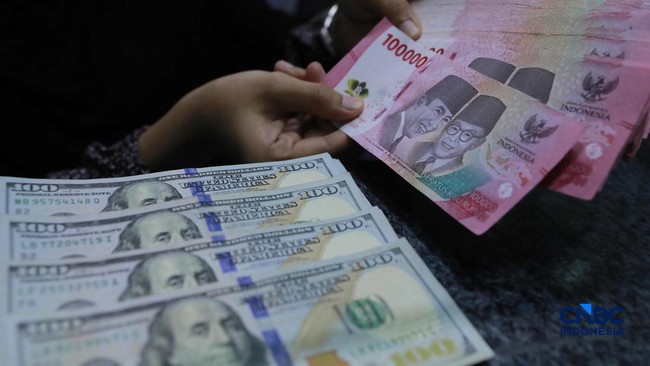
Jakarta, CNBC Indonesia - The rupiah exchange rate opened weaker against the US dollar on the final trading day of the week, Friday (8/5/2026).
According to Refinitiv data, the Garuda currency began Friday morning’s trading in the red, down 0.06% to Rp17,340/US$.
This weakening followed Thursday’s (7/5/2026) close, where the rupiah strengthened 0.29% to Rp17,330/US$.
Although it has returned to below Rp17,400/US$ after early-week pressures, several economists believe the rupiah faces ongoing depreciation risks into Q2-2026.
Head of Macro Economic and Market Research at Permata Bank, Faisal Rachman, explained that besides high global uncertainty and rising risk-off sentiment in financial markets, the current rupiah weakening is also influenced by seasonal factors, namely increased payments of domestic financial assets to non-resident investors, boosting US dollar demand.
“In Q2 2026, there is indeed a seasonal pattern of payments for returns on domestic financial assets to non-residents, leading to rupiah weakening,” Faisal told CNBC Indonesia, quoted Friday (8/5/2026).
On the other hand, lingering global uncertainties continue to haunt the rupiah, increasing risk-off sentiment.
Nevertheless, Faisal assesses that the depreciation pressure on the rupiah remains relatively contained, with the likelihood of breaching Rp18,000/US$ not too high.
“Depreciation pressure is likely to continue, but I think the rupiah will still manage to stay below Rp18,000,” he said.
In agreement, Global Markets Economist at Maybank Indonesia, Myrdal Gunarto, explained that the room for rupiah weakening is currently limited because capital outflow pressures are no longer as severe as earlier in the year.
This is because foreign investors have already largely exited the domestic stock market from January to March 2026. Therefore, the potential for further outflows is deemed not to be too significant.
“Because of foreign exchange demand. Even if there is capital outflow in the stock market, I think the pressure is not as great as in the early part of this year, so even if there are outflows in the stock market or the government bond market, the impact won’t be as large as in January, February, or March,” Myrdal told CNBC Indonesia, quoted Friday (8/5/2026).
Additionally, Bank Indonesia is considered to still have sufficient capacity to maintain rupiah exchange rate stability through interventions in the foreign exchange market and the government bond market.
Myrdal added that foreign investor interest in Indonesian government bonds remains quite high, especially when the yield on Government Bonds (SUN) rises close to the state budget assumption of 6.9%.
“When the yield approaches our state budget yield assumption of 6.9%, foreign investors immediately enter, so I think the impact from hot money outflows is starting to be limited,” he said.
Previously, Bank Indonesia Governor Perry Warjiyo explained that the rupiah weakening is a global factor due to rising geopolitical tensions triggering soaring oil prices, pressure from US interest rates, and a 4.41% increase in the dollar index (DXY).
This condition has triggered fund outflows from all countries, including emerging markets.
He conveyed this during the Financial System Stability Committee (KSSK) press conference on Thursday (7/5/2026).
Amid these dynamics, dollar demand in Indonesia is high in April to May, in line with the Hajj season, as well as dividend repatriation and external debt payments.
“The global conditions are like that, and coincidentally, seasonally in April-May, foreign exchange demand is high for us to pray that the umrah-Hajj community is healthy and successful, and to ensure dollar needs are met in April-May because corporations have a lot of dividend repatriation and external debt payments,” said Perry.
“Indeed, the conditions are such, BI is all out to protect the rupiah, with close coordination with the government and full support from the President,” Perry emphasised.