
Real Impact: QMB's CSR Programme Successfully Boosts Education and Revitalises...
Jakarta, TopBusiness – Amid the rapid growth of Indonesia’s national nickel downstream industry, which forms the backbone of the global electric vehicle battery supply chain, issues of sustainability and social responsibility are increasingly becoming primary concerns. Companies are no longer merely required to deliver economic performance but also to create measurable social and environmental impacts.
In this context, PT QMB New Energy Materials, a nickel processing company based on High Pressure Acid Leaching (HPAL) technology in the Indonesia Morowali Industrial Park (IMIP), demonstrates how Corporate Social Responsibility (CSR) strategies can become an integral part of a sustainable business model.
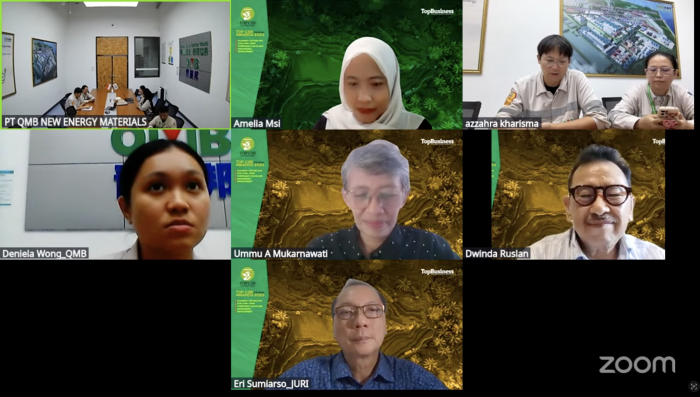
This was highlighted during the TOP CSR Awards 2026 judging interview organised by TopBusiness Magazine on Monday (27/4/2026), featuring Assistant General Manager of PT QMB New Energy Materials, Cao Changyu, and Senior ESG Staff, Daniela Wong.
As a company operating at the heart of Indonesia’s nickel industry, QMB recognises that its industrial activities have significant impacts on the surrounding environment and communities. Therefore, the CSR approach implemented is not symbolic but strategic and integrated.
In his presentation, Assistant General Manager of PT QMB New Energy Materials, Cao Changyu, emphasised that the company places sustainability as the primary foundation of its operations.
“We always strive to incorporate humanitarian values into every part of the company, with the aim of creating economic value, giving back to the community, and protecting the environment. Through our CSR programmes, we want to create shared value that not only impacts the company but also the community and environmental sustainability as a whole,” he stated.
He added that the CSR judging momentum serves as an important reflection for the company to continuously improve the quality of the programmes it runs.
“We believe that business success is not only measured by economic aspects but also by real contributions to society and environmental preservation. Therefore, we continue to integrate sustainability principles into every aspect of the company’s operations,” he continued.
Data-Based and Participatory, QMB’s CSR Developed Systematically
In line with the global industry’s transformation towards sustainable practices, QMB develops CSR programmes based on data and comprehensive social analysis.
Daniela Wong explained that the company conducts social mapping to identify the real needs of communities around the operational area.
“We realise that company activities bring both impacts and challenges, especially related to rapid urbanisation and population growth. Therefore, our CSR programmes are designed not only as obligations but as strategies to manage impacts responsibly,” she clarified.
This approach is strengthened through the regular preparation of sustainability reports and the implementation of dual materiality assessments involving various stakeholders, from communities, government, to business partners.
In 2025, QMB allocated a CSR budget of Rp41 billion with more than 5,000 beneficiaries. The programmes are run systematically, from planning to evaluation, involving communities as active subjects.
“Communities are not only beneficiaries but also involved as implementers through discussions, education, and capacity building. With this approach, we aim to encourage gradual community self-reliance,” Daniela added.
Educational Infrastructure Becomes Flagship Programme
One of QMB’s flagship CSR programmes that has come under the spotlight is the construction of educational infrastructure at SDN 4 Bawadopi, Morowali.
This programme arose from findings of a gap between the growing number of students and the capacity of educational facilities in the area.
“We saw an urgent need to increase school capacity. The number of students keeps increasing every year, while available facilities are still very limited. Therefore, we decided to intervene by building classrooms, access roads, and other supporting facilities,” Daniela revealed.
In addition to capacity factors, safety aspects were also a primary concern. Access to the school was previously deemed risky, especially during the rainy season, and there had even been accidents involving students.
Through this programme, QMB not only built classrooms but also improved access roads, drainage systems, and other supporting facilities.
Real Impact: School Capacity Increases, Local Economy Grows
The implementation of this CSR programme shows significant impacts, both in terms of education and the local economy.
The number of students at SDN 4 Bawadopi increased from 300 to 506 students in one year. The learning system became more optimal with adequate facilities and teaching staff support.
“After the construction, teaching and learning activities became much more effective. The improved road access also enhances student safety and comfort. In fact, the school has now become the centre of educational activities at the sub-district level,” Daniela explained.
Not only that, economic impacts are also starting to be felt. Infrastructure improvements have spurred new economic activities around the school, with an increase in the number of local business actors.
From an environmental perspective, the construction also contributes to reducing flood and congestion potentials in the area.
The community satisfaction index for this programme is also recorded high, at 86.13, making the school the top choice for the community.
QMB also complements the physical development programme with various human resource development initiatives.
Environmental education programmes, tree planting, and introduction to Mandarin language are part of efforts to improve education quality comprehensively.
“We ensure that the programmes do not