
Reading the President's Briefing from Within Our Own Homes
There was a time when a country was not in crisis, but also not truly moving forward. The numbers looked neat, stability was maintained, but in the grassroots spaces—in markets, small shops, household conversations—there was a pause that remained unanswered. Indonesia today is in that space.
The government, through various official statements, shows an economic foundation that cannot be ignored: strong foreign reserves around USD 151.9 billion, a debt ratio that is still controlled, and a fiscal deficit that remains managed—around 2.3% and in policy dynamics potentially widening to approach 2.9% of GDP, yet still disciplined below the safe limit of 3%. Credit is growing, investment continues to flow in, and macroeconomic stability is relatively maintained.
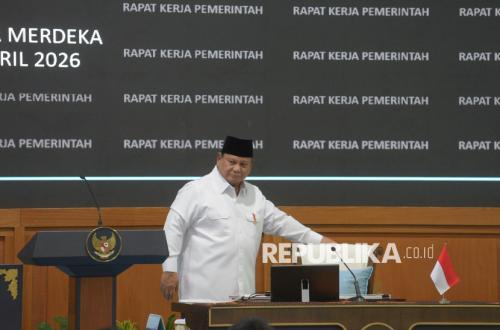
And in the cabinet working meeting at the State Palace on 8 April 2026, President Prabowo Subianto emphasised the necessary direction: budget discipline, focus on real impact, acceleration of execution, and favouring the people’s economy.
That direction is right. In fact, very right. But like all correct directions, it still needs one thing that is harder: accuracy in implementation.
This is where reality starts to speak in a different language. Household consumption—which supports more than half of our economy—is still moving, but not as strongly as before. The middle class is starting to hold back. MSMEs remain alive, but many have not yet developed.
A shop owner may not read fiscal reports, but he knows one simple thing: customers come, but they no longer buy like they used to.
Our economy grows in numbers, but has not yet fully grown in feeling. And it is precisely here that policies are tested.
The President’s briefing is essentially a call to shift from stability to execution. From preventing falls to the courage to leap.
However, our biggest challenge is no longer in policy formulation, but in the character of its implementation. We do not lack programmes. We often lack the courage to be honest in carrying them out.
It is time we say this clearly: no more presidential aides and their ranks who are mediocre in character and behave in a ‘just to please the boss’ manner.
This country does not need beautiful reports on paper that are fragile in the field. It does not need meetings full of success numbers but poor in honesty about difficulties.
In every coordination meeting, what is needed is not just achievements—but acknowledgment of obstacles. Get used to conveying difficulties that require breakthroughs and policy execution coordination—not just reassuring success numbers. Because only from that honesty can policies be improved.
On the other hand, we also face public noise that is no less disruptive to the direction. Criticism is still needed. It is part of democracy. But criticism that loses its data foundation is misleading. We see claims that the economy is collapsing, that the country has lost control, that nothing is running right anymore—narratives that sound strong but are fragile when tested.
Hoaxes muddy it. Emotions accelerate it. And in that fog, trust—which should be the foundation—is slowly eroded.
Yet without trust, there is no truly solid stability. No truly confident investment. No truly believed policy.
If we pull it further, Indonesia’s position today actually has a strong economic foundation. We are more stable than many developing countries, larger than some neighbours, and have a demographic potential rarely possessed by other nations.
But stability is not the end goal. It only gives us time.
The question is: do we use that time to transform, or just to survive? So reading the President’s briefing is not enough by just agreeing with it. We need to complement it.
The direction is already right. The foundation is already strong. But the next step demands:
• honesty in implementation
• courage in corrections
• and firmness in choosing quality, not just loyalty
In the end, this country’s future is not only determined by who leads, but by how those who carry out the leadership work—in silence, in meetings, in small decisions that determine the big direction.
And perhaps this entire discussion can be summarised in a simple but decisive reminder: If stability is not followed by honesty in execution, then it will only become a calm that delays problems. If discipline is maintained, if the courage to be honest is awakened, and if the quality of implementation is improved, then this already correct direction will not only keep us standing—but truly make us step forward.