
One Year On from Trump's Liberation Day, US Victory Not Fully Realised!
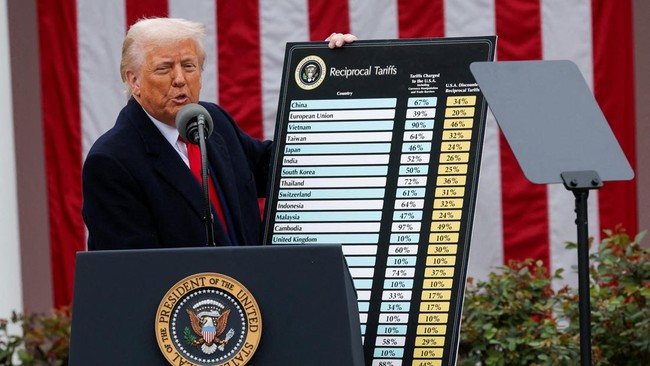
One year after US President Donald Trump launched sweeping tariffs that he called “Liberation Day,” the White House now claims highly positive results from the policy. The US government states that the trade deficit has narrowed, manufacturing investment is flowing strongly, factory activity is rebounding, and American workers are benefiting.
In an official statement released on the White House website on Thursday (2 April 2026), the US government even claims that its economy is now more resilient, more competitive, and safer than it was a year ago.
The Trump administration also emphasises that the “America First” trade policy has protected workers, generated new revenue from tariffs, improved trade relations, and accelerated the return of manufacturing to American soil.
However, a closer look at this year of trade war reveals a story that is not as straightforward as the narrative of victory being promoted by the White House. Some data do show beneficial changes for the US. But on the other hand, many of Trump’s grand promises have not fully materialised on the ground.
Trade Deficit Has Indeed Narrowed
One of the main claims by the US government concerns the sharp decline in the goods trade deficit.
The Trump administration states that the US goods trade deficit from April 2025 to February 2026 fell 24% compared to the same period a year earlier. The trade deficit with China is also claimed to have dropped 32% over the past year, while that with the European Union shrank by nearly 40%.
From this perspective, the US government has grounds to claim that the tariff policy has delivered results. Reducing the trade deficit has long been one of Trump’s primary targets.
For the government, the smaller the reliance on imports and the better the trade balance, the stronger America’s economic position vis-à-vis its trading partners.
However, the issue does not end there. A shrinking trade deficit does not automatically mean that the US industrial sector has truly recovered. The trade balance is just one measure. To assess whether the trade war has truly revived American manufacturing, the labour market, investment, and goods prices must also be considered.
Promises of Major Investment Not Fully Realised
The White House also claims that the trade war has triggered a wave of reshoring, or the return of industry to the US. The White House states that trillions of dollars in private and foreign investment are now flowing into the American manufacturing sector, from technology companies, automotive, to pharmaceuticals.
However, according to an article from the Tax Foundation, the picture is more cautious.
Data on foreign direct investment (FDI) into the US throughout 2025 does not show the dramatic surge repeatedly claimed by Trump.
Bureau of Economic Analysis data shows that foreign direct investment (FDI) into the US throughout 2025 did not show the dramatic surge repeatedly claimed by Trump. Total FDI in 2025 was recorded at US$288.4 billion, which is below the 10-year average of US$320.7 billion. That figure is also lower than the annual achievements in 2021, 2022, 2023, and 2024.
This means that, although there are many investment announcements and commitments from major companies, this has not yet been reflected as a major surge in macroeconomic statistics. In other words, the investment narrative sounds grand on paper, but its aggregate realisation has not yet shown the explosion promised.
Factory Activity Improving, But Jobs Not Yet Returning in Force
The Trump administration also highlights the recovery of manufacturing activity as evidence of success.
The US government states that factory activity indicators for January, February, and March 2026 show expansion, even reaching the highest levels since August 2022. Industrial production is also said to be at its highest level since 2019, while manufacturing productivity has recorded the largest annual increase in nearly two decades.
Simply put, this signals that the manufacturing sector is indeed starting to improve. However, recovery at the activity level has not yet fully been reflected in the labour market.
US Bureau of Labor Statistics data records that jobs in the manufacturing sector have actually continued to decline after Liberation Day. From April 2025 to February 2026, the number of manufacturing jobs decreased by around 89,000. This decline indicates that the promised industrial revival has not yet fully been reflected in the job market.
This becomes an important gap in the government’s victory narrative. Because if the trade war truly brings factories back to life on a large scale, then the manufacturing labour market should also start showing stronger recovery. In reality, that recovery is not yet clearly evident.
Tariffs Have Indeed Added to State Revenue, But Far from Bombastic Promises
Trump has sold tariffs from the start as a new revenue engine for the state. He once claimed that tariffs would bring hundreds of billions or even trillions of dollars to the government coffers, while also helping to pay off US debt.
In practice, tariffs have indeed increased customs revenue. US Department of the Treasury data shows that, before the US Supreme Court annulled the legal basis for IEEPA tariffs in February 2026, the policy generated around US$166 billion in tariff payments. Overall, customs duties for January-December 2025 reached US$264 billion.
The problem is that these figures remain far from the grand promises proclaimed by Trump and his advisors. There is indeed additional revenue from tariffs, but it is not large enough to approach the claim that this policy could be the main tool to pay off the national debt. Even federal debt continued to rise during that period.
In other words, the trade war has indeed provided additional money to the government, but the results are not as magnificent as the political narrative built from the beginning.