
OECD Cuts Indonesia's Economic Forecast, Only 4.8% Growth in 2026
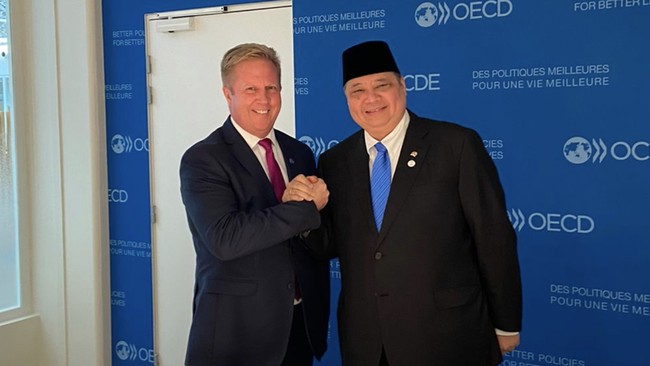
Jakarta, CNBC Indonesia - The Organisation for Economic Co-operation and Development (OECD) has revised downwards Indonesia’s economic growth for 2026 and 2027 amid rising global risks, primarily in the Middle East.
According to the latest OECD Economic Outlook, Interim Report titled Testing Resilience, released last week (26 March 2026), Indonesia’s economy is projected to grow by only 4.8% in 2026 and 5% in 2027. Previously, in the December 2025 report, the OECD had estimated Indonesia’s economy could grow by 5% in 2026 and 5.1% in 2027.
For context, this OECD projection is lower than the macroeconomic assumptions in the 2026 State Budget, which stand at 5.4%. It is even further from Finance Minister Purbaya Yudhi Sadewa’s target of 6% growth for this year.
The revision is attributed to the ongoing war in the Middle East. Not only Indonesia, but nearly all countries are facing downward revisions in growth projections.
India is projected to grow by only 6.1% in 2026, while China’s economy is expected to slow to 4.4%. Meanwhile, globally, the OECD forecasts economic slowdown to 4.8% in 2026.
“The conflict in the Middle East is testing global economic resilience. The outlook is shrouded in high uncertainty and reflects the interaction of two opposing forces,” the OECD stated in its report, quoted on Monday (30 March 2026).
On the positive side, the OECD sees growth supported by strong momentum in investment and production related to technology, lower tariffs than previously assumed, and the continuation of strong results from 2025.
On the negative side, the halt in shipments through the Strait of Hormuz and the closure and damage to some energy infrastructure have caused a surge in energy prices and disrupted global energy and other key commodity supplies, such as fertiliser.
“This increases costs, suppresses demand, and adds inflationary pressure,” the OECD explained.
However, the OECD also warns that prolonged disruptions to shipments through the Strait of Hormuz or sustained closures of oil and gas facilities could lead to much worse outcomes.
The OECD has included simulations in this report exploring a scenario where oil and gas prices rise far above the baseline projection - about a quarter higher in the first year and remaining elevated thereafter - combined with tighter global financial conditions.
“In this case, global GDP could be around 0.5% lower in the second year, while consumer prices would be higher by about 0.7 percentage points in the first year and 0.9 percentage points in the second year,” the OECD stated.