
North Sumatra Pioneers Indonesia's First SDGs Business Registration System
The North Sumatra Provincial Government (Pemprov Sumut) has officially begun drafting the Initial Draft Regional Action Plan (RAD) for Sustainable Development Goals (SDGs) for 2026–2030.
This strategic step was marked by the opening of a public consultation held at the Adimulia Hotel in Medan on Monday (6/4/2026).
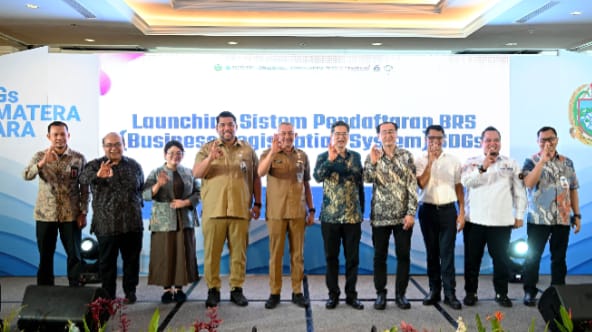
The event also served as a key moment with the launch of the Business Registration System (BRS) for SDGs, a digital business registration system claimed to be the first in Indonesia to integrate the role of the business world into sustainable development targets.
The system was officially launched by the Acting Secretary of the Provincial Government (Pj Sekdaprov) of North Sumatra, Sulaiman Harahap.
In his remarks, Sulaiman emphasised that the RAD SDGs 2026–2030 is not merely an administrative document. Its preparation is based on Presidential Regulation Number 111 of 2022, with support from competent experts.
“This document is compiled comprehensively based on valid data and an evidence-based policy approach. We want to ensure that development in North Sumatra is inclusive, equitable, and adaptive to social and economic dynamics with the principle of No One Left Behind,” said Sulaiman.
He also encouraged the implementation of the Build Forward Better initiative, an approach to building North Sumatra to be more resilient, safe, and sustainable, particularly in disaster risk mitigation and strengthening infrastructure resilience.
Meanwhile, the Head of the Regional Development Planning, Research, and Innovation Agency (Bapperida) of North Sumatra, Dikky Anugerah, outlined several macro indicator targets in the RAD SDGs 2026–2030. Among them, economic growth is targeted at 7.6 percent, per capita income at Rp115.3 million, poverty rate reduced to 2.82–3.82 percent, and the open unemployment rate lowered to 4.75 percent.
In addition, the Human Development Index (IPM) is targeted to continue improving. “SDGs are no longer an additional agenda but the main framework for regional planning that aligns with the RPJPD and RPJMD,” Dikky stressed.
He explained that the launch of the BRS is the result of collaboration between the North Sumatra Provincial Government, the SDGs Center of Universitas Sumatera Utara (USU), and the Japan International Cooperation Agency (JICA).
The system, Dikky continued, aims to transform private sector partnerships to be more structured and measurable.
To date, 199 business actors have registered in the BRS system, with a target of reaching 500 SMEs in 2026. Japan was chosen as a reference due to its success in integrating sustainable development practices into its business registration system, he stated.
Hisaaki Mitsui, IDJC Consultant for the JICA SDGs Project, also appreciated the initiative. He stated that North Sumatra’s SDGs business registration system has the potential to become a model for other provinces in Indonesia.
“Congratulations to the business actors who have registered,” he said.
The event was also attended by representatives from Bank Indonesia (BI), the Financial Services Authority (OJK), the Indonesian Chamber of Commerce and Industry (Kadin) of North Sumatra, heads of regional apparatus, and representatives from regency/city governments across North Sumatra.