
Ministry of Agriculture Strengthens Chicken Production Regulation to Protect Farmers
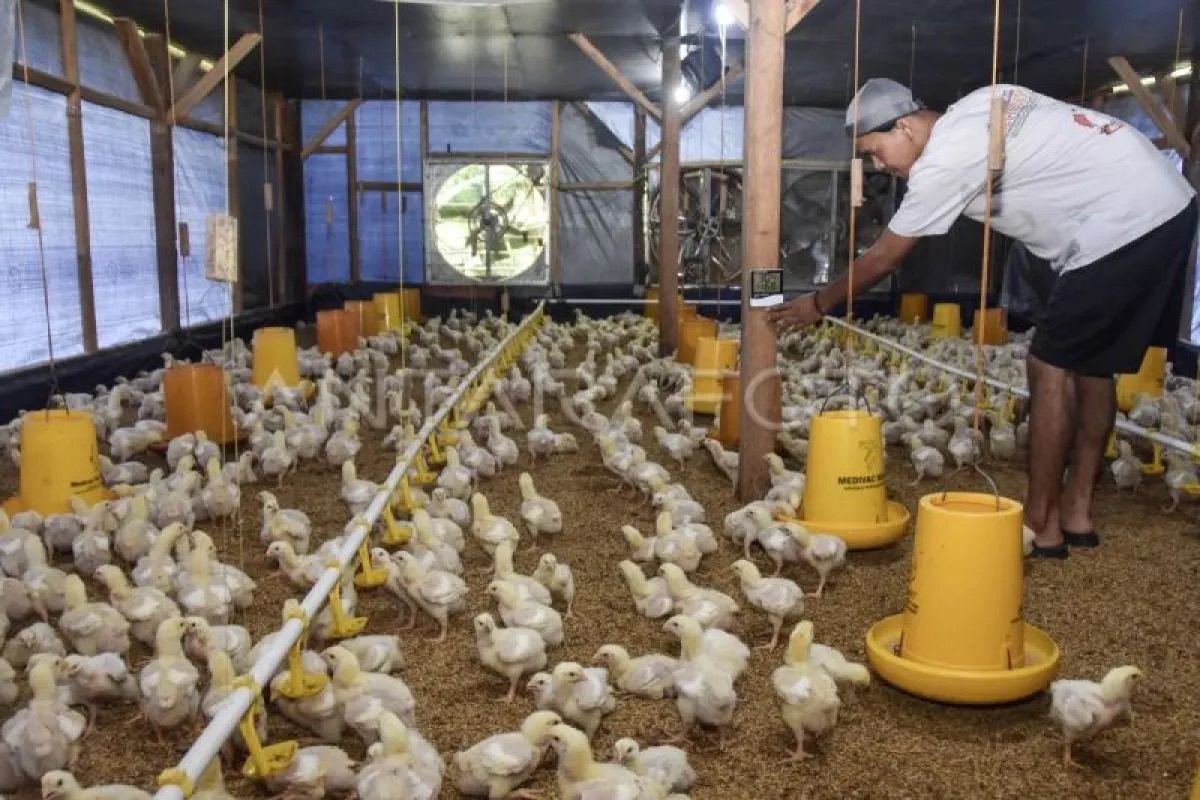
The Ministry of Agriculture (Kementan) is strengthening the management of production and supply of national broiler chickens as part of efforts to maintain price stability and the sustainability of the livestock farming business.
“This step is carried out through the arrangement of measured and adaptive seed imports to align with market needs,” said the Director of Livestock Breeding and Production at the Directorate General of Livestock and Animal Health of Kementan, Hary Suhada, in Jakarta on Thursday.
He stated that this policy is important because it directly affects the stability of the poultry sector. Controlled production is expected to maintain supply and price stability, thereby providing income certainty for farmers.
These efforts were discussed in the Quarterly Evaluation Meeting on the Importation of Grand Parent Stock (GPS) broiler chickens, held virtually. The evaluation focused on optimising the first-quarter realisation and strengthening future production regulation strategies.
Based on reporting data, Hary continued, in the first quarter, the cumulative GPS broiler importation realisation was 87,150 Day Old Chicks (DOC), and for GPS layer, it was 2,995 chicks. These seed imports serve as a reference for the government to improve the accuracy of sustainable production regulation.
Hary said the government continues to refine the governance of seed imports to make it more precise and in line with national needs.
“Planning and realisation of GPS imports continue to be synchronised with national needs, so that production regulation can run more optimally,” he said.
He explained that the implementation of the National Stock Replacement (NSR), which will begin in early 2026, serves as the main instrument in maintaining production balance. The timing of imports and distribution is carried out more measured to keep supplies stable in every period.
“For farmers, the implementation of NSR provides production stability certainty, so that farm-level prices can be maintained and businesses remain sustainable,” said Hary.
In addition, the government is also encouraging improvements in seed quality through strengthening genetic quality and production performance. This step is expected to increase farmer productivity as well as the competitiveness of the national poultry subsector.
On the supply side, Hary added, opportunities for GPS sources are increasingly open, including from Australia and the United Kingdom, which have harmonisation agreements with Indonesia. This policy strengthens the availability of GPS as the main source of national broiler chicken seeds.
Expert from the Analysis Team on the Supply and Demand of Broiler Chickens and Consumption Eggs at the Directorate General of Livestock and Animal Health of Kementan, Trioso Purnawarman, emphasised the importance of maintaining production balance to keep the market stable.
“The distribution of NSR needs to be maintained proportionally, so that supply continuity and market stability can be preserved,” he added.
The Ministry of Agriculture emphasised that strengthening the governance of broiler chicken production is part of the state’s responsibility in protecting farmers while ensuring price affordability for the public.
With increasingly precise production regulation, the government is optimistic that the national poultry sector will become more stable, farmers will be protected, and the public’s need for animal protein will continue to be met.
Chairman of the Poultry Breeding Companies Association (GPPU), Dawami, assessed that price stability greatly depends on proper production management.
“With good production regulation, price stability can be maintained, providing certainty for farmers and consumers,” he said.