
Launched in East Java, This Is the Target of the National Inflation and Food Security Control Movement
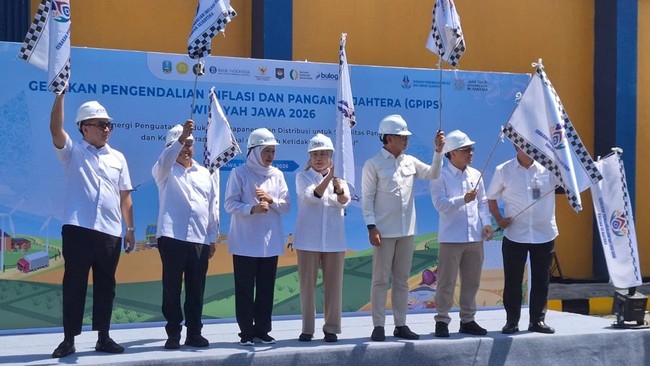
The national inflation and food security control movement needs strengthening, especially given the increasing complexity of challenges in realising food resilience.
Various inflation-control programmes, implemented consistently through the synergy of the Central Inflation Control Team (Tim Pengendalian Inflasi Pusat) and the Regional Inflation Control Teams (TPID), have so far proven capable of maintaining national inflation stability. The inflation measured by the Consumer Price Index (IHK) in April 2026 stood at 2.42% year on year. Meanwhile, inflation in the volatile food group remained controlled at 3.37% year on year, within the target range of 3.0%-5.0% as agreed at the High Level Meeting of the Central Inflation Control Team (29 January).
Bank Indonesia has again launched the National Inflation and Prosperous Food Control Movement (GPIPS) in Sidoarjo, East Java. GPIPS is an enhancement of the previous programme known as the National Food Inflation Control Movement (GNPIP).
Through GPIPS, the food-inflation control programme is formulated in line with priority programmes to achieve food security, energy, and financial stability.
Ferry Irawan, Deputy for Coordination of Management and Development of State-Owned Enterprises at the Coordinating Ministry for Economic Affairs, explained that GPIPS is a strategic movement that orchestrates inflation, with inflation targets of 2.5% plus/minus 1% in 2026.
‘The Inflation and Food Control Movement is a strategic part that we will continue to push to guard both CPI and food inflation,’ he said at the launch of the GPIPS for the Java region in East Java, on Wednesday (13 May 2026).
He also stressed that the authorities are pushing Inter-Regional Cooperation (KAD) to maintain food supply across regions. According to him, KAD is an ammunition in facing a severe drought season.
‘In this Java region, we hope to broaden the involvement of local governments, including East Java Province, as well as Perumda or BUMD and BUMN logistics,’ he asserted.
Deputy Minister of Home Affairs Bima Arya said inflation that is not controlled will affect purchasing power, increase production costs, and attract investment. Therefore inflation-control efforts must be the concern of all parties.
‘We must ensure that national programmes are monitored. This is the work context of the inflation-control teams at both central and regional levels and the fast-track economic growth teams that tie everything together. I think the programme was initiated by Bank Indonesia and the context is to safeguard growth,’ he explained.
East Java is chosen as the host of GPIPS Java 2026 due to its strategic role in the national food-resilience map. Production data for 2025 show East Java’s dominance in almost all major food commodities, namely rice, maize, bird’s eye chilli, and red onions.
Moreover, East Java is the largest producer of paddy with a contribution of 17.34% of national production, with total output reaching 10.57 million tonnes. This dominance is also reflected in East Java being the top producer of maize and bird’s eye chilli, while red onion production ranks second nationally.
Beyond production capacity, East Java holds a strategic position as a regional trading hub for the eastern Indonesia region, known in the national connectivity map as the New Nusantara Gate. Through Tanjung Perak Port, East Java becomes a key distribution hub linking food logistics flows from Java to Sulawesi, Nusa Tenggara, Maluku, and Papua.
During the event, East Java Governor Khofifah Indar Parawansa said that East Java has so far implemented an Inflation Control Display (EPI) as a tool to strengthen inter-regional cooperation to mitigate input-price volatility. In EPI, each region can coordinate prices between provinces and municipalities within East Java.
‘We have frequently emphasised that the connectivity between markets — market to market, and how inter-regional cooperation works — this is something we are still doing,’ she said.
Bank Indonesia Deputy Governor Aida S. Budiman said that GPIPS is implemented with a strengthened application of the 4K strategy: affordability of prices, availability of supply, smooth distribution, and effective communication.
‘Through GPIPS, the control of food inflation is not only focused on short-term price stabilisation, but also on strengthening production, post-harvest, and distribution of food to support sustainable national food security,’ she said.
GPIPS 2026 focuses on two main aspects: strengthening productivity and ensuring smooth distribution of food, in order to maintain price stability and national food security. The three priority commodities across all regions are rice, chilli, and red onions.
Additionally, there are three main areas highlighted in GPIPS compared to the previous programme. First, strengthening programme alignment with government priorities, especially in supporting increased production, strengthening distribution, and stabilising strategic food to support the Asta Cita agenda towards self-sufficiency in food.
Second, strengthening programme implementation through more concrete and inclusive activities involving farming groups, business actors, MSMEs, and BUMD food, including strengthening the role of farmer institutions and regional food off-takers. Third, strengthening Inter-Regional Cooperation, including KAD schemes with B2B components, to bolster distribution efficiency and maintain supply balance across regions.
‘The strengthening of short-term interventions (for example, discount markets) is also pursued under the ’three rights’ principle: right time, right place, and right target, to optimise the effectiveness of food-inflation control,’ he said.
Meanwhile, for additional commodities other than the three core, adjustments will be made according to the characteristics of each region, from Sumatra, Java, to …