
Investment Board accelerates business registration for micro-enterprises through self-declared spatial compliance
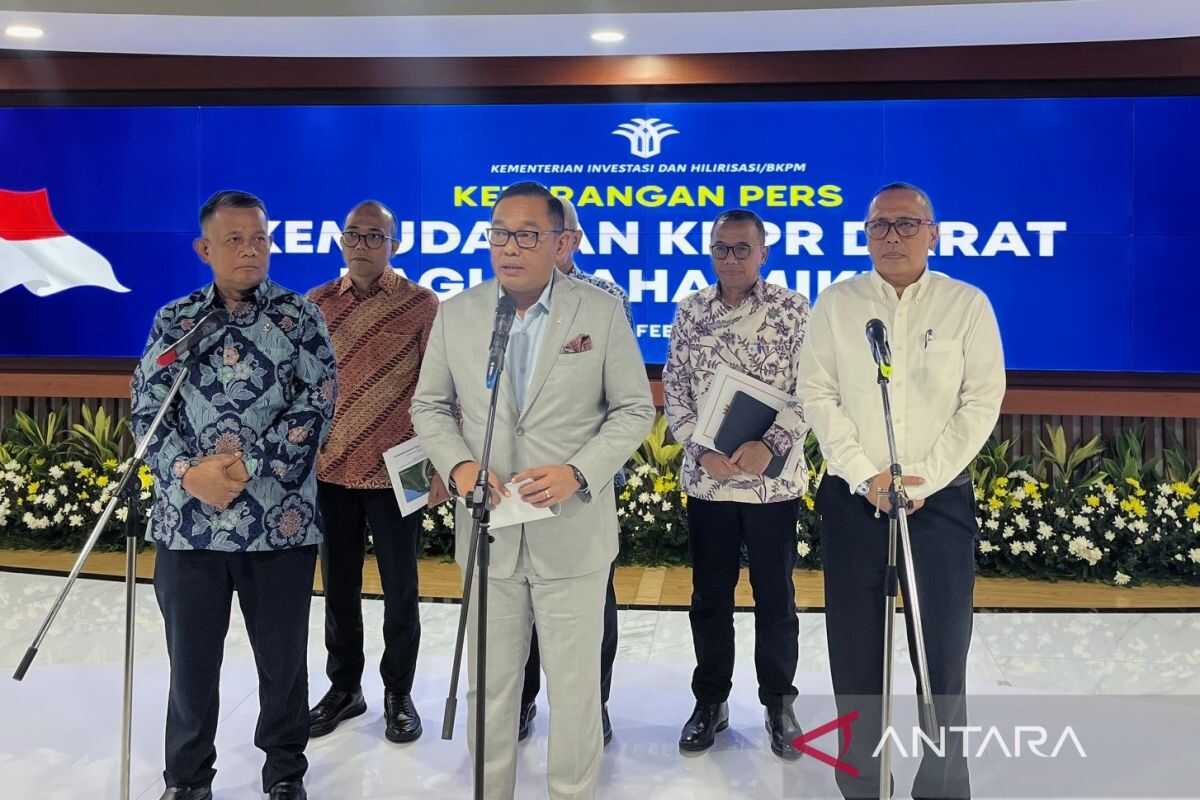
PKKPR for micro-enterprises can be carried out through a self-declaration, with a mechanism that allows for automatic approval.
Jakarta (ANTARA) – The Ministry of Investment and Downstreaming/Coordinating Board for Investment (BKPM) is accelerating the process of issuing Business Identification Numbers (NIB) for micro-enterprises by simplifying the approval process for spatial utilisation activity compliance (PKKPR).
Deputy Minister of Investment and Downstreaming/Deputy Head of BKPM, Todotua Pasaribu, in Jakarta on Tuesday, explained that delays in issuing NIB were mainly due to the requirement to have a location permit or PKKPR, as stipulated in Government Regulation No. 28.
According to him, the PKKPR process takes time because of a number of technical requirements, which creates bottlenecks and delays in the issuance of NIB for micro-enterprises.
As a solution, the Ministry of Investment and Downstreaming/BKPM has issued a Circular Letter from the Minister of Investment and Downstreaming/Head of BKPM No. 1/S of 2026 regarding the provisions for issuing spatial utilisation activity compliance for micro-enterprises.
Through this regulation, he said, PKKPR for micro-enterprises can be carried out through a self-declaration, with a mechanism that allows for automatic approval, so that micro-enterprises can obtain NIB more quickly.
“We have issued this circular letter, and in the next three months, we will upgrade it into a ministerial regulation, the content of which is that for micro-enterprises or for those involved in micro-enterprises, the PKKPR, or what people used to know as a location permit, can now be done through a self-declaration,” he said.
Todotua said that micro-enterprises only need to include the location point and business address in the self-declaration without the need for verification so that the NIB can be issued. This policy applies to micro-enterprises with low, medium, to high levels of risk.
He also revealed that to date, around 15,226,905 NIBs have been issued through the OSS system, and around 14.9 million of them belong to micro-enterprises.
Meanwhile, Deputy Minister of MSMEs, Helvi Moraza, emphasised the importance of facilitating licensing to encourage formality that is legally protected and to improve the level of MSMEs.
The Ministry of MSMEs, Helvi continued, has various coaching, education, and training programs to encourage informal businesses to become formal. According to him, in this process, the NIB is one of the important requirements.
Based on the ministry’s data, there are around 56 million MSMEs recorded, but only about 14.6 million have NIB through OSS.
On the other hand, the Director General of Spatial Planning at the Ministry of Agrarian and Spatial Planning/National Land Agency (ATR/BPN), Suyus Windayana, explained that previously, in Government Regulation 28, the mechanism of self-declaration for PKKPR only applied to low-risk micro-enterprises.
Through this new circular letter, the scope is expanded so that micro-enterprises with low, medium, to high risks can also use self-declaration.
However, for businesses with high risk, business actors are still required to confirm with the Spatial Planning Office in their respective regions.