
Interior Minister Tito Emphasises Integrated Waste Management Approach
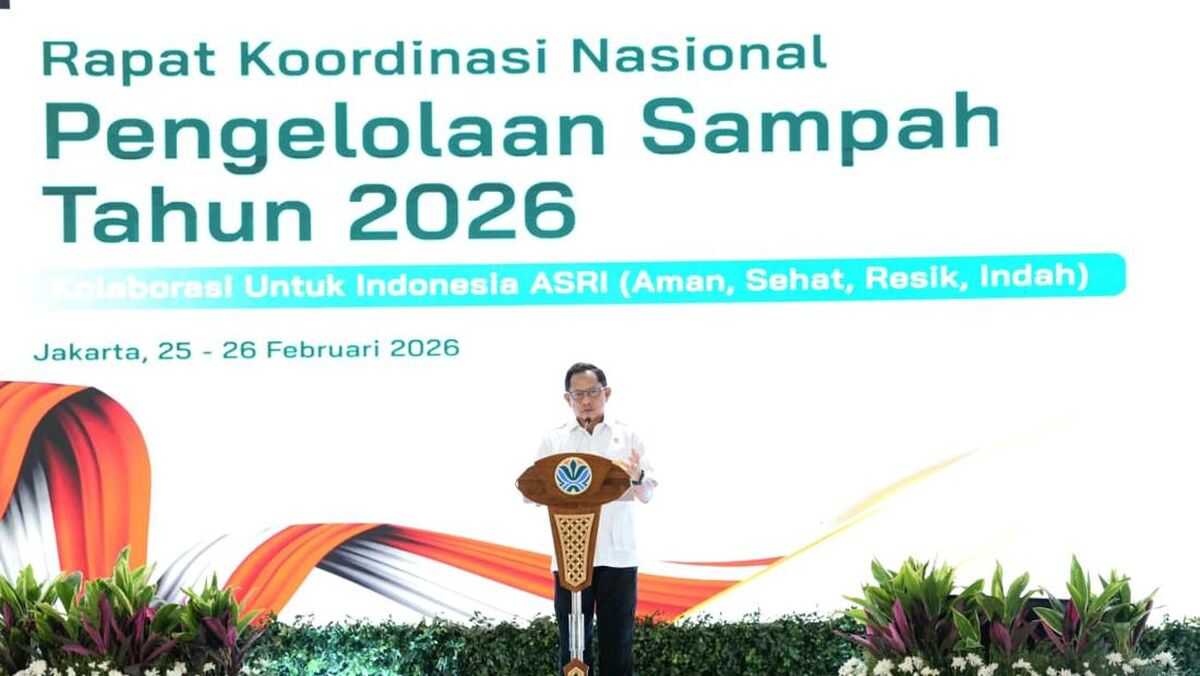
The government has emphasised that waste management can no longer be conducted in a piecemeal fashion. Management must be integrated from upstream to downstream to address escalating waste volumes whilst opening new economic opportunities.
Interior Minister Muhammad Tito Karnavian stated that a comprehensive approach is key to handling the nation’s waste problem systematically and sustainably. This was conveyed during the National Waste Management Coordination Meeting (Rakornas) 2026, themed “Collaboration for Indonesia ASRI (Safe, Healthy, Clean, Beautiful)” at Balai Kartini Building in Jakarta on Wednesday, 25 February.
In his remarks, Tito revealed that Indonesia currently ranks among the world’s five largest waste producers and sits in third place as a contributor of plastic waste to the ocean. He considered these conditions should serve as a momentum for collective evaluation. “I just want to add some data to ensure this event is not merely ceremonial but becomes a wake-up call for the umpteenth time,” Tito said.
He emphasised that waste is not merely a cleanliness issue but also directly impacts public health and holds economic value if managed properly.
The Interior Minister outlined that waste management strategy can be divided into three approaches: upstream-based, downstream-based, and integrative. The upstream approach focuses on reducing waste at its source, from households to village level.
“The upstream-based approach is environment-based and household-based. So each household takes action, each neighbourhood takes action, RT, RW, villages for example, they implement reduce from the beginning, reducing waste and then processing waste in their respective environments,” he explained.
He cited several regions such as Banyuwangi, Klungkung, and Subang that were deemed successful in implementing community-based waste management through early sorting, thus reducing waste volume entering final processing facilities (TPA).
Additionally, the Interior Minister highlighted the economic potential of organic waste processing through maggot farming or Black Soldier Fly (BSF) larvae cultivation. This innovation is deemed capable of reducing waste volume whilst generating value-added products such as animal feed and fertiliser, in line with circular economy principles.
On the downstream side, he stressed the importance of strengthening waste transport and processing systems, particularly in urban areas with high volumes. Technology utilisation is considered a solution provided it is supported by consistent governance and monitoring.
Through this Rakornas, the Interior Minister hopes waste management will no longer be reactive but become a structured and sustainable collaborative movement. “Cities stay clean because waste collection teams move quickly. So in the morning there is no waste,” he concluded.
The event was also attended by Coordinating Minister for Food Affairs Zulkifli Hasan, Environment Minister/Head of Environmental Control Agency Hanif Faisol Nurofiq, Minister for Population and Family Development/Head of the National Family Planning Agency Wihaji, Deputy Environment Minister Diaz Faisal Malik Hendropriyono, Deputy Minister for Villages and Disadvantaged Regions Development Ahmad Riza Patria, as well as numerous governors, regents, and mayors.