
ICDX Chief: Global Conflict Makes Gold Price Difficult to Stabilise
JAKARTA – Global geopolitical turmoil is expected to continue influencing movements in world commodity prices throughout 2026. Strategic commodities such as gold and crude oil are projected to remain volatile amid economic and international political uncertainty.
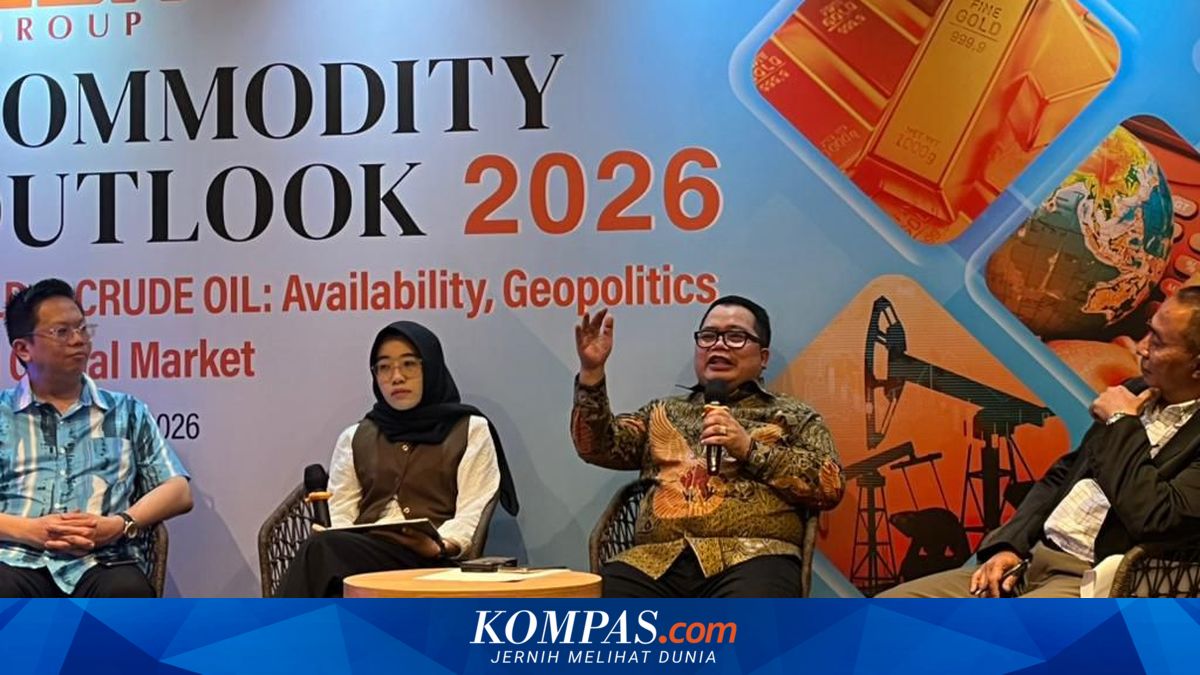
This emerged during the ICDX Commodity Outlook 2026 event held by the Indonesia Commodity & Derivatives Exchange (ICDX) in Jakarta on Wednesday, 11 March 2026. The forum discussed the prospects for gold and crude oil commodities under the theme “Gold & Crude Oil: Availability, Geopolitics and Global Market”.
ICDX Director Nursalam said the information presented at the forum was expected to serve as a reference for business operators in formulating their business strategies.
“We hope that the information we present in the Commodity Outlook 2026 can serve as a reference for business operators in making and determining their strategic policies this year,” Nursalam said in Jakarta on Wednesday, 11 March 2026.
“Developments in global geopolitics, particularly in the Middle East, will undoubtedly have some impact on the prices of crude oil and gold commodities,” he added.
Throughout 2025, multilateral transactions in crude oil-based commodity contracts at ICDX reached 61,260 lots. Meanwhile, transactions in gold-based commodity contracts reached 1,627,698 lots.
Crude oil contracts were dominated by COFRMic contracts with 51,548 lots traded. This micro futures contract uses the West Texas Intermediate (WTI) price benchmark with a size of 10 barrels per lot.
Gold contracts were dominated by GOLDUDMic with 682,310 lots traded. This contract is a micro version of the GOLDUD contract, sized at 1/100 of the standard contract or equivalent to 0.01 contract.
ICDX Research and Development Analyst Tiffani Safinia said 2025 was one of the best periods for gold in recent decades.
“The year 2025 became one of the best years for gold in several decades, whilst strengthening its role as a safe-haven asset and diversification instrument amid global uncertainty,” Safinia said.
Throughout 2025, gold prices rose 64 per cent with 53 all-time highs recorded. The highest record was $4,550 per troy ounce on 26 December 2025, with an average price of approximately $3,431 per troy ounce.
Tiffani cited several factors driving the increase, including three interest rate cuts by the Federal Open Market Committee (FOMC) totalling 75 basis points, Middle East conflicts, and geopolitical tensions between the United States and China.
For 2026, gold prices are projected to remain elevated. She said gold prices could potentially range from $5,500 to $6,000 per troy ounce through the end of the year.
Based on a Reuters survey of 30 international analysts and traders, the median projection for 2026 gold prices stood at $4,746.50 per troy ounce, an increase from the previous estimate of $4,275.
“The year 2025 was a challenging year for crude oil commodities. The average price movement of this black gold recorded a decline of more than 21 per cent to the level of $60 per barrel at the end of 2025,” said Girta Putra Yoga.
That price fell from an average early-year level of $77 per barrel.
In the first half of 2025, crude oil prices fell nearly 10 per cent with an average around $69 per barrel. The decline was triggered by the tariff war imposed by US President Donald Trump against China and several trading partners such as Canada and Mexico.
Oil prices even briefly touched $62 per barrel in May 2025 before recovering after the United States and China agreed to a 90-day tariff truce.
Entering 2026, oil prices surged again, driven by geopolitical tensions.
“Geopolitical tensions in early 2026, ranging from the arrest of Venezuelan President Nicolás Maduro by US military to the US–Iran war, drove crude oil prices up to touch $90 per barrel in early March,” Girta said.
That price increased from around $57 per barrel in early January 2026.
According to him, crude oil prices have the potential to continue strengthening through the second half of 2026. Resistance levels are estimated to be in the range of $95–$100 per barrel, whilst support levels are projected in the range of $75–$80 per barrel.
Major factors that will influence oil price movements include developments in Middle East conflicts, OPEC+ production policies, and US trade tariff policies.