
Gresik Customs Office Destroys 8.59 Million Illegal Cigarettes and 203.5 Litres of Illicit Alcoholic Beverages
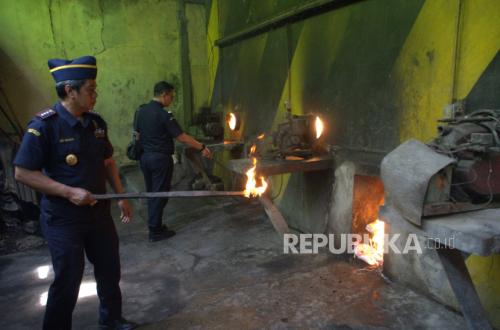
REPUBLIKA.CO.ID, GRESIK – The Gresik Customs Office has destroyed 8.59 million illegal cigarettes and 203.5 litres of illegal ethyl alcohol-containing beverages (MMEA). The destruction was carried out at the incinerator owned by PT Tri Surya Plastik in Malang Regency on Thursday (30/4/2026).
The Head of the Gresik Customs Office, Asep Munandar, revealed that the destroyed goods were the result of excise enforcement actions and had the status of state-owned goods (BMMN).
The destruction was performed by burning in an incinerator machine to eliminate the physical form and utility of the items, ensuring they cannot be reused.
“This is aimed at protecting the public from the dangers of illegal and/or hazardous goods, securing state revenue, and creating a healthy trading environment,” Asep stated in a press release on Tuesday (5/5/2026).
Asep detailed that the destroyed items included 8,594,288 illegal cigarettes, comprising 7,651,264 white machine-made cigarettes (SPM) and 942,976 machine-made clove cigarettes (SKM), as well as 203.5 litres of illegal MMEA.
According to him, the total value of the destroyed goods is estimated at Rp12.7 billion, with potential state losses averted amounting to Rp10.1 billion.
“This achievement results from continuous intensive supervision conducted from November 2025 to February 2026. In addition to serving as accountability for managing state-owned goods, this activity educates the public on recognising illegal cigarettes and preventing their circulation,” Asep said.
Member of Commission XI of the House of Representatives on finance and fiscal matters, Thoriq Majiddanor, assessed that the Gresik Customs Office’s performance reflects the effectiveness of fiscal oversight functions, directly impacting the protection of state revenue.
He also emphasised the importance of ongoing synergy between law enforcement agencies, local government, and public participation to narrow the operational space for illegal businesses.
This destruction implements a comprehensive regulatory framework, from Law No. 11 of 1995 as amended by Law No. 39 of 2007 on Excise, to various derivative regulations governing the management of state-owned goods from customs and excise enforcement actions.
This demonstrates that every step taken is not only results-oriented but also upholds the principles of legal certainty and accountable governance.
“Going forward, we will continue to strengthen synergy with law enforcement agencies and other stakeholders to ensure optimal supervision. We also invite the public to actively participate by reporting the circulation of illegal goods,” Asep concluded.