
Government and Private Sector Agree on Communal Transmigration Land Use for Cattle Industry
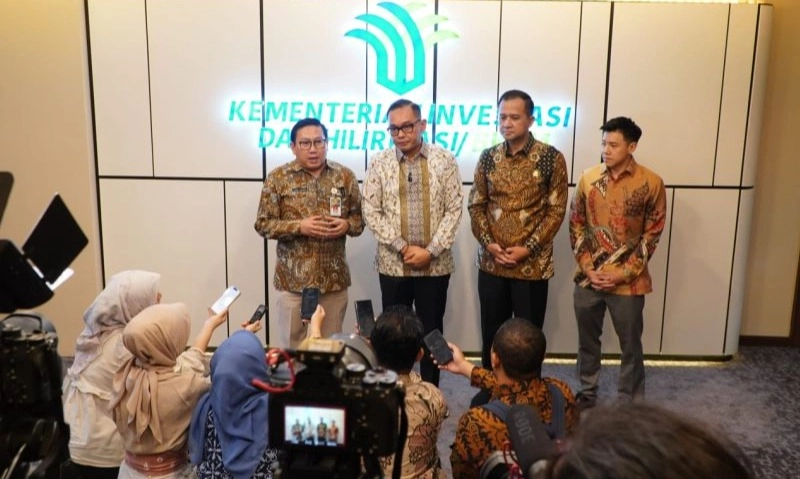
JAKARTA - The Ministry of Investment and Downstreaming/BKPM, the Ministry of Transmigration, the Ministry of Agriculture, and PT Asia Beef Biofarma Indonesia have agreed on a new concept and programme to strengthen the domestic cattle industry through the utilisation of communal transmigration land.
The effort to strengthen the cattle farming ecosystem involves managing transmigration land communally through community corporations. All parties hope this initiative will attract investment whilst delivering economic benefits.
“The ultimate goal of all this is for us to be self-reliant in meeting our meat and milk needs. In line with the President’s wishes and directives, with our population now reaching 300 million, we must suppress imports as much as possible,” said Deputy Minister of Investment and Downstreaming/BKPM Todotua Pasaribu in Jakarta on Saturday (17/5).
The programme is also expected to support industrial downstreaming and help deliver the Free Nutritious Meals (MBG) programme.
Minister of Transmigration Iftitah Sulaiman explained that this new concept emerged due to land scarcity problems in the cattle industry. Her ministry proposed utilising 3.1 million hectares of transmigration land under Land Management Rights (HPL) schemes, as well as 525,995 hectares of transmigration land currently being developed for investor use.
Iftitah said the transmigration land would be managed communally through community corporations to enable business cooperation arrangements (KSU), benefiting both communities and investors. She described the concept as novel, noting that transmigrants were previously given two hectares of land to manage, but now only receive a house and yard.
“We are converting these community corporation assets into equity in the form of shares distributed to the community,” she added.
To advance the plan, Director General of Livestock and Animal Health at the Ministry of Agriculture, Agung Suganda, said his office would detail the concept further next week and conduct a pilot project in East Sumba, East Nusa Tenggara (NTT), to build a cattle farming ecosystem on transmigration land.
According to his calculations, every 10,000 hectares of transmigration HPL land could support 5,000 productive breeding cows, including a processing and downstream ecosystem.
“This is a pilot project that we hope to realise this year, and Asia Beef together with the Indonesia-Brazil Cattle Consortium are ready to facilitate and support it in terms of funding, technology, and building the ecosystem,” Agung said.
In the same forum, Todotua further explained that a comprehensive cattle farming ecosystem could support the Free Nutritious Meals programme whilst reducing imports.
“Our main target is to reduce imports as much as possible. This is highly promising. Investors have already explained that Indonesia has great potential for developing this. We just need to consolidate on a large scale,” Todotua said.
The pilot project for the cattle farming ecosystem in East Nusa Tenggara, discussed on Friday (16/5), is expected to begin implementation in 2025. All parties have begun discussions to create a national cattle ecosystem investment covering both beef and dairy cattle along with their downstream ecosystems.
“There will be a dairy industry there, and most importantly we can support one of the government’s programmes regarding meat needs for the Free Nutritious Meals programme,” he said.
The cattle farming ecosystem concept encompasses an agricultural livestock ecosystem within a downstreaming framework, consolidating all available strengths, particularly land resources. Indonesia’s consumption demand still falls far short when it comes to beef and milk needs. The NTT pilot project will be managed as a single ecosystem, with an industrial downstreaming zone concept developed around it.
“The ultimate goal of all this is for us to be self-reliant in meeting our meat and milk needs. This is the programme, in line with the wishes and directives of the President, to find ways for Indonesia’s population of 300 million to suppress imports as much as possible,” Todotua said.