
Even if the Strait of Hormuz is Reopened, It Won't Be Enough: The Energy Crisis Will Persist for a Long Time
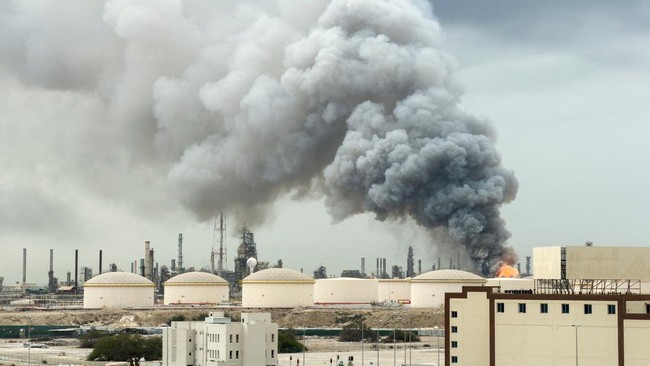
Jakarta, CNBC Indonesia - The war in the Gulf region has now entered its fourth week. Every day, as Iranian attacks on ships continue to keep the Strait of Hormuz closed, approximately one-fifth of the world’s oil and liquefied natural gas (LNG) production remains stalled and unable to flow to global markets.
This means that every day, market players are updating calculations on the size of the global energy supply lost this year. The larger the estimated supply loss, the higher the energy prices.
Brent crude oil prices have indeed stabilised at US$99 per barrel today, Wednesday (25/3/2026) at 14:57 WIB. Brent crude prices once reached US$119 per barrel on 19 March 2026, or 76% more expensive than before the war broke out. Meanwhile, gas prices in Europe have surged 85%.
The reason energy prices have not risen much higher is that investors still hope the supply flow will recover soon.
According to Société Générale, cited from The Economist, the number of bets in the financial markets predicting prices will fall, or put options, still outnumber bets that prices will rise, or call options, for delivery in July and beyond.
In other words, factoring in shipping delays, investors still hope conditions will return to normal by May.
According to The Economist’s calculations, if Iran complies with Donald Trump’s threat on Saturday (21/3/2026) to reopen the strait within 48 hours or face attacks on its power plants—which remains a likely but uncertain possibility—the global oil and gas markets will still face supply shortages for months. This situation will ultimately burden the world economy.
The Energy Market Will Not Recover Quickly
The first problem starts with production. Unable to export and facing storage limitations, Gulf countries have collectively cut their crude oil production by 10 million barrels per day.
That figure equals 10% of global production and 40% of their pre-war production levels.
To restore production to previous levels, producers cannot simply turn everything back on immediately. They must first ensure all facilities are still functional, clear pipeline blockages, then restart oil wells by gradually restoring pressure to avoid damaging reservoirs. After that, initial processing facilities such as separators, compressors, and treatment plants also need to be reactivated. All these processes require additional time.
Indeed, as OPEC members, Gulf countries are accustomed to raising and lowering production in just a matter of days.
However, this cut is far more sudden and deeper than anything they have faced before. Experts estimate the process will take between two and four weeks.
For the energy market to balance again after Hormuz reopens, three things must happen.
First, Gulf producers must return production to pre-war levels. Second, ships must transport that supply to refineries abroad. Third, those refineries must process it into usable fuel. Each stage in this industrial chain requires time.
The gas market situation appears even more complicated. Ras Laffan in Qatar, which supplies nearly one-fifth of the world’s LNG, has been shut down since 2 March 2026 after an Iranian drone attack. In the past week, missile strikes damaged two of the 14 gas liquefaction units at the facility. That damage equals 17% of the plant’s capacity and 3% of global supply.
Qatar’s Energy Minister said repairs will take three to five years, while expansion plans will also be delayed. The extent of damage at other sites remains unclear. However, even for facilities with lighter damage, weeks of repairs will likely be needed before operations can resume.
But repairs are only the initial stage. After that, all equipment must be cleared of moisture to prevent pipes from cracking when recooled to minus 160 degrees Celsius.
If this process is done too quickly, the metal will shrink unevenly, and welded joints could break. Anne-Sophie Corbeau from Columbia University estimates the entire process could take up to seven weeks.
The next stage is shipping. If a ceasefire occurs, most captains of the approximately 480 ships currently stranded in the Gulf are likely to want to see several attack-free days before attempting to leave.
Most tankers are already fully loaded, and the Strait of Hormuz can handle heavy traffic, so the queue could be cleared in about two weeks. After that, in theory, new ships could enter to transport the slowly recovering production.
However, in practice, it is unlikely that many ships will be willing to enter immediately in the coming weeks. Iran has attacked port facilities in various Gulf areas, including fuel tanks, warehouses, and berthed ships. Major terminals appear largely intact, but some damage may not yet have been disclosed.
Additionally, sunken ships or damaged infrastructure may need to be cleared first to ensure safe navigation routes. John Ollett from Argus Media said repairs to docks or loading equipment usually take months.
Another issue comes from insurance. Most war risk insurance in the area has been cancelled. Insurance companies still willing to provide coverage are now raising premiums from the previous 0.2% to 0.4% of the ship’s value to 1% or more. For the riskiest voyages, the figure can reach 10%.
Anyone with internet access can find out the owner or charterer of a ship, so ships that te