
DJKA Data Reveals Numerous Unofficial Crossings in Java and Sumatra
JAKARTA, KOMPAS.com – Accidents at level crossings have occurred again, including an incident involving a taxi and a train in Bekasi. This event once more highlights safety conditions at points where roads and rail lines intersect.
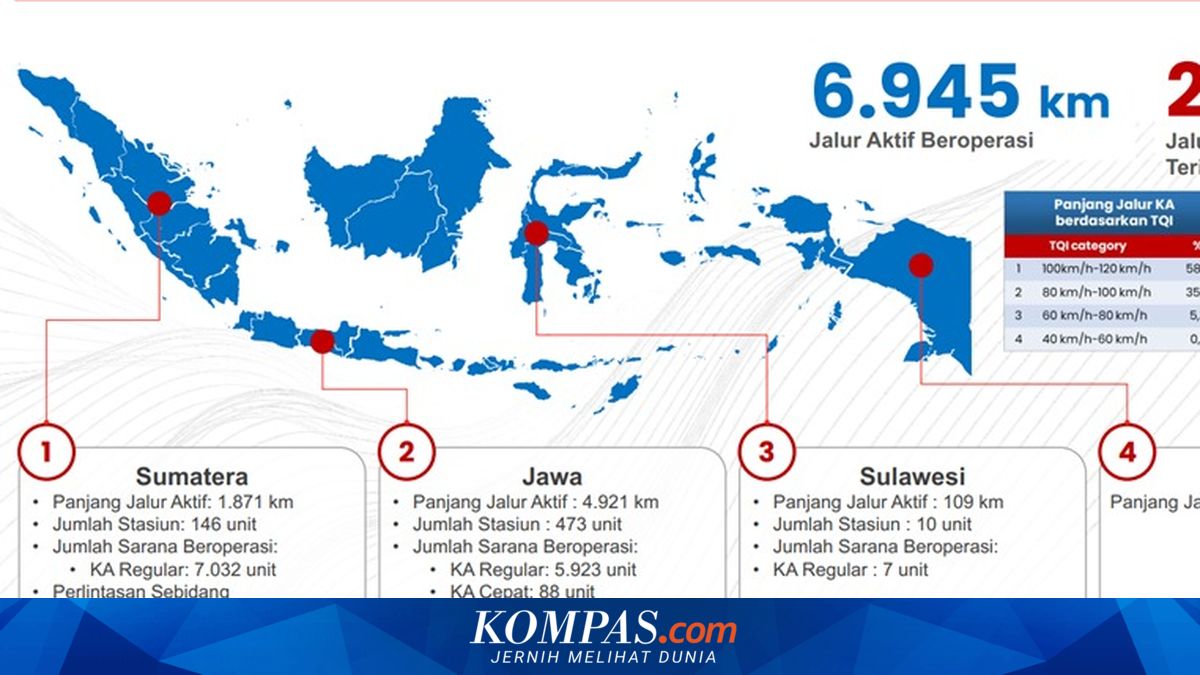
Data from the Directorate General of Railways shows that Indonesia’s railway network currently comprises 6,945 km of active operational tracks. However, there are still 2,233 km of identified non-active tracks.
From an operational perspective, the number of railway vehicles is concentrated in Java with 473 units, followed by Sumatra with 146 units, and Sulawesi with 10 units.
Amid these conditions, level crossings remain a crucial point. In Java, there are 1,388 guarded official crossings and 1,019 unguarded ones, as well as 456 unofficial crossings.
Meanwhile, in Sumatra, there are 210 guarded official crossings, 113 unguarded, and 507 unofficial crossings.
Transportation observer Djoko Setijowarno assesses that accidents at level crossings are part of road traffic accidents.
“If an accident occurs at a crossing, it falls under the category of road accidents, not railway accidents,” he told Kompas.com on Wednesday (29/4/2026).
According to him, road traffic accidents occur every day with a large number of victims, but they do not always receive the same attention.
“Every day more than 80 people die on the roads, but it often does not become a serious concern,” said Djoko.
He stated that the safety issue at crossings is not only related to technical aspects but also involves policy and comprehensive handling.
“The problem is how far the state truly prioritises safety,” he said.
In addition, Djoko added that in several locations, especially unofficial crossings, their existence is often linked to the access needs of residents and economic activities in the surrounding areas.
“In some places, crossings have even become a source of income for the local community,” he said.