
DIY Tourism Office Facilitates Certification for Batik Artisans to Boost Industry Competitiveness
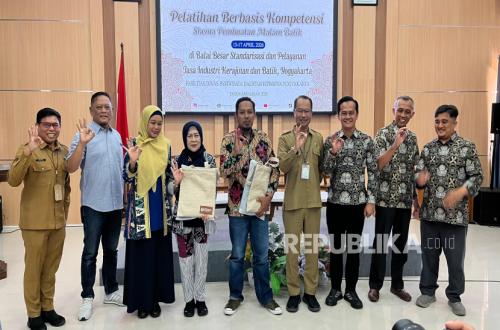
REPUBLIKA.CO.ID, YOGYAKARTA – The Centre for Standards and Services for Craft and Batik Industries (BBSPJIKB) is collaborating with the Yogyakarta Special Region Tourism Office to organise training and professional certification in the creative economy (ekraf) sector, specifically in the craft subsector focusing on the batik wax-making scheme. This programme targets facilitating certification for 175 ekraf actors in DIY through 2026.
Head of the Creative Economy Development Division at the DIY Tourism Office, Iwan Pramana, stated that the first batch of training was held from 13–17 April 2026, involving 20 batik artisans who passed the selection process. Participants come from various regions in DIY and are required to have experience in the batik field.
According to him, this programme is an effort to enhance the capacity of ekraf actors not only in terms of skills but also through competency recognition via certification.
“So this is a form of support for improving the capacity of creative economy actors, especially in Batik Crafts. In addition to enhancing their competencies, we will also carry out certification. Then, how to increase the product value, as mentioned, this is also part of product improvement,” he said when met on the sidelines of the training event on Monday (13/4/2026).
Iwan explained that the training also aims to promote the sustainability of the batik industry in DIY, including waste management and production efficiency. He did not deny that batik production costs are still dominated by wax usage. Therefore, innovation in managing this material is key to increasing artisans’ incomes.
“Almost 70 percent of batik production costs are for wax, so we are (looking for ways) to reduce it. Now, when costs are reduced, their incomes automatically increase further,” he said.
In addition to improving efficiency, the training also addresses the need for competency recognition for artisans who have not yet been formally certified. Gradually, training and certification facilitation will be provided to other creative economy actors in the developing DIY region, as well as empowering local communities.
“There are 17 subsectors in the creative economy, so there are many, from design, culinary, crafts, fashion, then games, animation, television, radio, advertising, so we take those that really have many practitioners in DIY,” he said.
According to him, certification for creative economy actors is very important, especially for artisans who have worked in the craft sector for years but have not received recognition for their expertise in creating products.
“They have been working in batik all this time, but have not received recognition for their skills. So today, besides providing training again, we are giving competencies. (This is beneficial) when they are later asked to be instructors, they already have national certification recognition. Because this is not just competency-based training, but there will also be BNSP certification,” he revealed.
For this year, the DIY Tourism Office targets certification for 175 ekraf actors, divided into six to eight batches. He reiterated that certification is important as official recognition of artisans’ skills, while also opening opportunities for them to become instructors in the future.
Meanwhile, Member of Commission B of the DIY DPRD, Rifki Listianto, emphasised legislative support for the development of MSMEs, including the creative economy sector. With this programme, the government hopes that batik actors in DIY will become more competent, efficient in production, and able to present innovative, environmentally friendly products with high economic value.
“Regarding the support mentioned, we from the DIY DPRD friends, especially Commission B, are fully committed to encouraging the growth and development of MSMEs. Clearly, we are pro-MSMEs, and today one of them is in the ekraf field,” he said.