
Demand for Halal Lifestyles is Growing, but Gen Z Admits it Remains Difficult to Abandon Conventional Finance
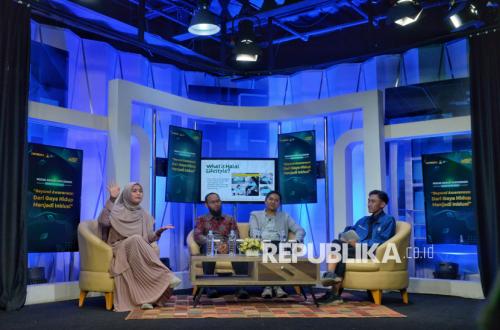
REPUBLIKA.CO.ID, JAKARTA – Awareness of halal lifestyles among young people is considered to be continuously increasing. However, many from Generation Z admit that they still find it difficult to abandon conventional financial services because their daily needs are better met by these systems.
From university payments and digital transactions to educational administration requirements, many activities still rely on conventional services which are perceived as more practical and easily accessible.
A student at UIN Sunan Kalijaga Yogyakarta, Muhammad Ridho, said that young people today place great emphasis on the ease of use and user experience of applications when choosing financial services. According to him, conventional platforms are still considered faster and more flexible than Sharia-compliant services.
“Generation Z tends to consider service flexibility, speed of access, and application user experience,” said Ridho during a focus group discussion (FGD) titled “Beyond Awareness: From Lifestyle to Inclusion”, which was part of the Road to ISF 2026 series held by Republika together with FoSSEI on Wednesday, May 13, 2026.
Ridho said that payment systems for education and various daily needs, which are still dominated by conventional services, mean that students have become accustomed to using non-Sharia services.
A student at the University of Education in Indonesia, Bagas, said that people are actually starting to adopt some aspects of a halal lifestyle. However, Sharia services are still considered more complicated than conventional services.
“People hope that Sharia services will have the same ease and quality as conventional services,” he said.
According to Bagas, people do not reject the concept of Sharia, but rather want services that are convenient, fast, and easy to use in their daily activities.
Still limited to discussions
A student at the State University of Jakarta, Muhammad Galang, said that discussions about Islamic economics have so far been mostly confined to student organizations such as KSEI and FoSSEI.
According to him, real-world implementation on campus is still limited, so the use of Sharia services has not yet become a daily habit for students.
“Campuses need to encourage real-world implementation, for example through programs that promote the use of Sharia accounts for students,” said Galang.
Galang believes that education about Islamic economics should not be limited to seminars or discussion forums. According to him, campuses need to help build an ecosystem that supports the use of Sharia services in daily activities.
He said that his organization even has a program to encourage the use of Sharia accounts for its members to familiarize them with Sharia-based transactions.