
BI Chief Outlines 3 Channels of Impact from US-Israel vs Iran War on the Economy
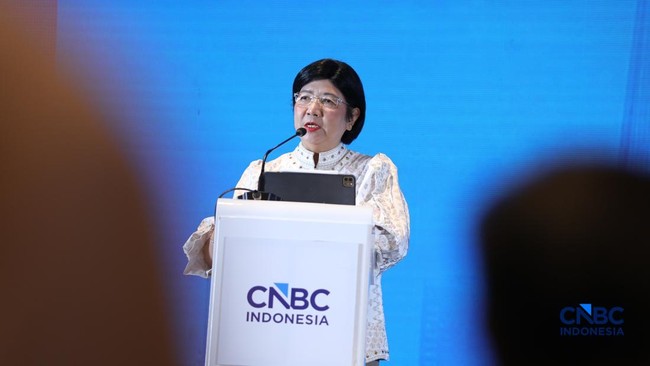
Jakarta, CNBC Indonesia - Bank Indonesia’s (BI) Senior Deputy Governor Destry Damayanti has shared the impacts of the Iran versus Israel and United States (US) war on the global economy, including Indonesia.
BI divides the impacts of this war into three channels, namely the financial channel, commodity prices, and trade or production.
“The first channel is the financial one. The point is that this channel is tightening. The direct impact of Iran-Israel is not a global financial hub. The market reaction in the Middle East is limited. But the indirect impact is significant because it involves the US as a global financial hub,” said Destry at the Central Banking Forum 2026 themed ‘Indonesia’s Economic Resilience in Facing Global Exchange Rate Volatility’, in Jakarta on Monday (14/4/2026).
Destry revealed that the indirect impact from this channel includes risk-off sentiment where investors avoid risks in the market, thus increasing safe haven activities. As a result, this condition triggers capital shifts from developing countries to advanced economies. This causes the US dollar index to rise. Indonesia also feels this risk.
“Like it or not, flows to advanced economies, including the US DXY (dollar index), are increasing. Flows to emerging markets, not just in Indonesia, are also decreasing,” said Destry.
Destry confirmed that Indonesia is affected by this situation, but the Indonesian market still records capital inflows into Government Securities (SBN), stocks, and Bank Indonesia Rupiah Securities (SRBI).
“Flows to emerging markets are not just to Indonesia but also decreasing. In Indonesia, it is felt although there are inflows into SBN, a little into stocks, SRBI. But overall outflow of Rp 21 trillion,” explained Destry.
Furthermore, the second channel is commodity prices. The direct impact is on oil prices. This direct impact is because Iran blocks the Strait of Hormuz, which is a strategic global shipping route.
According to BI’s calculations, Destry stated that Iran’s oil production is only 5%, but the Strait of Hormuz contributes 20% to global oil trade.
“This increases oil prices, so oil prices three days ago had reached a US-Iran agreement. But last night there was no agreement yet. As a result, everything rises, DXY rises above 100, regional currencies in advanced economies experience weakness,” she explained.
The indirect impact from the closure of the Strait of Hormuz and rising oil prices affects other commodity prices. BI sees rises in gold, coal, aluminium, and CPO prices.
“Coal has just risen because it is preparing alternative energy. CPO rises. The indirect impact is quite good for Indonesia because there is coal, CPO, gold. The impact has two sides: oil prices rise but export commodities also increase,” said Destry.
Then, the third channel is trade and production. According to Destry, in terms of trade, Iran’s contribution to global GDP is only 1%, and its global exports-imports are below 1%.
However, due to obstacles in the Strait of Hormuz, there is disruption in the UAE and Saudi Arabia, so there is indirect impact on other countries, including China, Iraq, Turkey, and India, which are global production centres.
“This increases shipping and logistics costs, so there is global supply chain disruption. In conclusion, global commodity prices rise, gold, coal, nickel, agriculture also rise. The latest is plastic because of supply chain, ultimately leading to production decline,” said Destry.
From these three channels, Destry stated that global GDP or economy will slow down and inflation will rise.
“This is called stagflation, which is not good. Policy responses become important. Some countries’ fiscal policies will be loose. Monetary policy that trends downward will be more cautious because now there is a competition to make domestic assets attractive,” she emphasised.