
Bamsoet Emphasises that Legal Renewal Must Deliver Substantive Justice
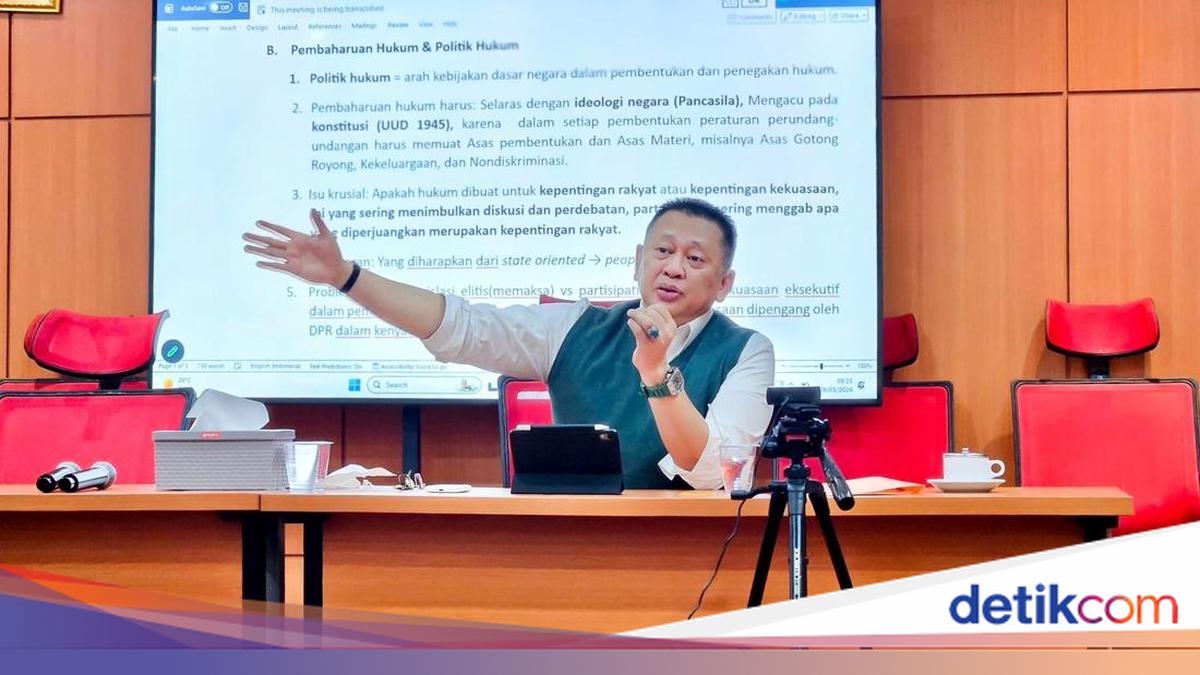
He stated that in the past, the law was more oriented towards state power, but now society demands law that favours the interests of the people. This change is evident from the increasing public criticism of the legislative process, which is seen as elitist and lacking public participation.
In the formation of various strategic laws, waves of rejection from students, academics, civil society organisations, and social media demonstrate that the public is increasingly aware of the importance of citizen involvement in the legal process. The phenomenon of ‘viral-based law’ is even emerging, where law enforcement often moves quickly after a case gains significant attention on social media.
“The law must be able to deliver a sense of justice that is truly felt by society. Without comprehensive renewal, the law will continue to be viewed merely as a tool of power, not a means to bring social justice for all Indonesian people,” said Bamsoet in his statement on Monday (11/5/2026).
He made these remarks while teaching the course ‘National Legal Renewal’ in the Doctoral Programme in Law at Borobudur University Jakarta campus on Saturday (9/5/2026).
The 20th Chairman of the DPR RI and 7th Chairman of Commission III of the DPR RI explained that one of the biggest challenges in national legal renewal today is the gap between ‘law in books’ and ‘law in action’. Many regulations are considered ideal on paper, but their implementation falls far short of expectations.
According to him, in terms of law enforcement, society still often questions practices of selective law enforcement, legal treatment imbalances, and low integrity of officials. Data from Transparency International in the Corruption Perceptions Index in recent years also shows that Indonesia still faces serious issues in governance and anti-corruption efforts. At the same time, society demands a legal system that is faster, more transparent, and humane.
“Legal change is not enough to stop at amending laws. What is more important is changing the legal culture, the integrity of officials, and the state’s courage to deliver substantive justice for society,” said Bamsoet.
The Deputy General Chairman of the Golkar Party and Deputy General Chairman of KADIN Indonesia assessed that criminal legal renewal through the new Criminal Code (KUHP) and Code of Criminal Procedure (KUHAP) can become an important momentum for reforming the national legal system. After more than a century using the legacy of Dutch colonial law, Indonesia is now beginning to enter a new era of national criminal law that shifts from a retributive approach to a more humane one, including strengthening restorative justice and protecting citizens’ rights.
“For decades, we have been trapped in a highly formalistic colonial legal system. The reform of the KUHP and KUHAP must be the gateway to the birth of a more humane, modern legal system that guarantees the constitutional rights of citizens,” explained Bamsoet.
Furthermore, the Chairman of the Board of Trustees of the Association of Doctoral Law Alumni of Padjadjaran University added that the success of national legal renewal greatly depends on the synchronisation between legal substance, institutional structure, and societal legal culture.
According to him, bureaucratic reform, transparency of law enforcement institutions, strengthening judicial review, and public participation in law-making are important factors in restoring public trust in the law.
“Legal renewal is an effort to build justice that lives among society. If the law can be trusted by the people, then democracy will be strong and the state can function well,” Bamsoet concluded.