
ASN WFH Policy Takes Effect This Week: Check the Schedule and Rules!
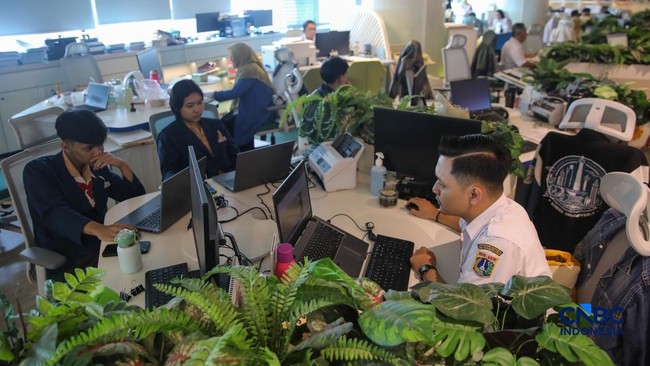
The government has established adjustments to the implementation of official duties for Civil Servants (ASN) as a concrete step in implementing a transformation of more efficient, adaptive, and performance-based government governance.
This policy is outlined in the Circular Letter of the Minister of State Apparatus Empowerment and Bureaucratic Reform (PANRB) Number 3 of 2026 on the Implementation of Official Duties for ASN Employees in Government Agencies, which takes effect on 1 April 2026.
Minister of PANRB Rini Widyantini explained that this adjustment serves as a guide for government agencies in regulating the implementation of ASN official duties more flexibly while prioritising organisational performance.
“Through this policy, we encourage the implementation of official duties that is more efficient, effective, adaptive, and digitally based, thereby increasing ASN productivity and the quality of public services sustainably,” said Rini in her statement, quoted on Monday (6/4/2026).
The adjustment to the ASN work pattern is carried out through a combination of work location flexibility, namely four office workdays (work from office/WFO) from Monday to Thursday and one workday from home/residence which is the ASN’s domicile location (work from home/WFH) on Friday.
Nevertheless, Rini emphasised that this policy does not change the provisions for workdays and hours for ASN, but rather an adjustment to the work method that remains oriented towards performance achievements.
“Work flexibility must still align with performance target achievements. The main focus remains on output and outcomes, not on the work location,” she stressed.
Employee Proportion Arrangements
In its implementation, Rini explained that Personnel Development Officials (PPK)/Heads of Government Agencies in each agency are given the authority to regulate the proportion of employees and the mechanism for implementing official duties according to the characteristics of tasks and services.
The government also emphasised that this adjustment must not disrupt government operations and the quality of public services. Therefore, agencies are required to ensure that essential services remain available and accessible to the public.
“Health, security, cleanliness, population, and emergency services must continue to operate optimally, including ensuring services that are friendly to vulnerable groups,” explained Rini.
In addition to work pattern arrangements, the government is also encouraging efficiency measures in agency operations, including restrictions on official travel, optimisation of online meetings, reduction in the use of official vehicles, and more prudent use of office energy.
The application of digital technology and information systems is also key in supporting the effectiveness of this policy’s implementation, including aspects of attendance and ASN performance reporting.
“To ensure optimal implementation, each agency is required to conduct periodic monitoring and evaluation of organisational performance achievements, energy efficiency, and public service quality,” stated Rini.
In particular, the results of this evaluation must be submitted to the Minister of PANRB, and for local governments also to the Minister of Home Affairs, at the latest on the 4th of the following month.
Additionally, further technical guidelines for ASN in local government environments will be established by the Minister of Home Affairs to ensure alignment of policy implementation at central and local levels.
Public Services Must Not Be Disrupted
House of Representatives Speaker Puan Maharani highlighted the government’s policy of setting work from home (WFH) every Friday for ASN as an effort to save Fuel Oil (BBM) amid the Middle East conflict. Regarding this policy, Puan emphasised the importance of maintaining public service productivity.
“ASN WFH is not just about flexibility, but about whether the state still works when the office is not full. ASN work flexibility will be judged by whether the state serves the people quickly or not,” said Puan, quoted from the DPR website, on Monday (6/4/2026).
She understands that this ASN WFH policy is one of eight national work culture transformations as an adaptive and preventive step, especially in responding to global geopolitical dynamics. The government stated that the policy has been calculated based on post-COVID-19 handling experience.
The government stated that the WFH policy aims to encourage the implementation of a digital-based work system while increasing efficiency. Puan assessed that the WFH policy for civil servants every Friday will be directly tested by one measure that is most easily felt by the public.
“Whether public services continue to run at the same speed when the bureaucratic work pattern changes,” she said.
According to her, Friday was chosen as the WFH implementation day, although some local governments decided to implement it on another day, because the workload on Friday is considered not as heavy as on other days.
“Of course, the DPR supports the government’s efforts for effectiveness and adaptability. However, what needs to be a joint concern is how to ensure that public services continue to run despite the implementation of ASN WFH,” said Puan.