
Accelerating the deliberations of the Gig Worker Bill, Deputy Chairman of Commission V invites civil society to actively engage
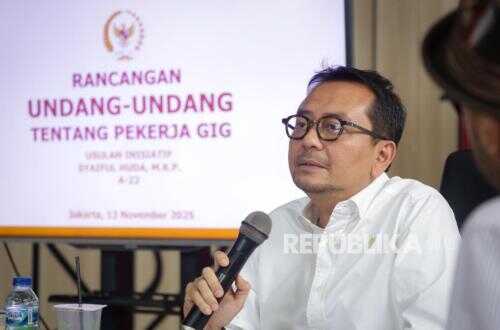
Deputy Chairman of Commission V of the Indonesian House of Representatives (DPR RI), Syaiful Huda, urged civil society to actively participate in guarding and pushing for the acceleration of the deliberations of the Gig Worker Bill in Indonesia. Public involvement is seen as the key to breaking the stalemate in Parliament, which has appeared to move forward and backward due to overlapping interests.
This was stated by Syaiful Huda at a public discussion organised by the Centre for Indonesian Policy Studies (CIPS) in Jakarta on Wednesday, 4 March 2026. The discussion also featured Theodore Sutaro, Assistant Deputy for the Digital Economy at the Coordinating Ministry for Economic Affairs; Ambrosius Emilio, Advocacy Policy Division member of Sindikasi; and Lily Pujiati, Chair of the Indonesian Transport Workers Union (SPAI). In addition, representatives from APINDO, Gojek, Indrive, and other online service providers attended.
“Broad involvement from various quarters in the debate will provide moral and political support to the government and the Parliament. We need pressure from civil society so that the much-anticipated gig workers law can be completed swiftly,” said Huda.
The PKB politician said that discussions of the Gig Worker Bill in Parliament have been hampered by the many overlapping interests, resulting in a prolonged legal vacuum in the digital economy and self-employment sectors.
“In fact, millions of gig workers or independent workers in Indonesia are currently working without meaningful legal protection. Their status as self-employed workers has not been accommodated in the existing law (the Labour Act). If there is no breakthrough, this vulnerability will persist for a long time,” he asserted.
Huda cited the plight of online transportation workers as a stark illustration of injustice on the ground. Driver partners often face non-transparent income deductions, tip deductions, and unclear algorithms, with no strong mechanism for appeal. Moreover, the lack of social protection poses a serious threat to their livelihoods.
“Similar vulnerabilities also loom over other professions in the creative sector, such as film crew, content creators, and other creative workers. They all operate in a legal grey zone,” he added.
The PKB DPP chair said he had launched the rights initiative to draft the Gig Worker Bill. The initiative’s draft includes several key points as protections for gig workers and business operators. Among the key points are clarity of gig workers’ status, a clear net income threshold, clarity on engagement duration, algorithm transparency, and a mechanism for resolving industrial disputes.
“We are very open to input to refine the initiative for the Gig Worker Bill that we have proposed,” Huda said.