
Accelerating Islamic Economic Literacy, BI West Java Launches Friday Sermon Book
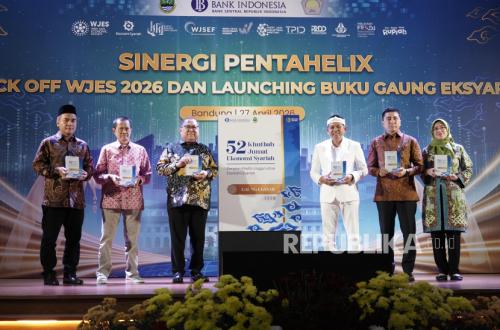
To accelerate the improvement of Islamic economic literacy, the West Java Representative Office of Bank Indonesia has launched the book “52 Friday Sermons on Islamic Economics: Echo of Gaung Eksyar” at the Pasundan Hall, Bank Indonesia Building in Bandung, on Monday (27/4/2026).
The launch of this book is part of the Superior Preacher Movement for Islamic Economics and Finance (Gaung Eksyar) programme. The book was compiled by national calibre experts in Islamic economics and finance.
Among them are Adiwarman Azwar Karim, SE, MBA, MAEP, Prof Dr M Syafii Antonio, M.Ec, and KH Muhammad Cholil Nafis, Lc., PhD, and it features innovations such as the use of Sundanese language in some scripts to strengthen the connection of the message with the community.
“This initiative is expected to accelerate the increase in national Islamic economic literacy from 50.18 percent in 2025 to 70 percent in 2030,” said the Head of the West Java Bank Indonesia Representative Office, Muhammad Nur, in a statement on Tuesday (28/4/2026).
The compilation of this book has received appreciation from national figures, including Prof Dr KH Didin Hafidhuddin and Prof Dr KH Miftah Faridl, who consider the book a guiding light for preachers in delivering more applicable Islamic economic da’wah to empower the community’s economy.
Nur hopes that preachers and mosque managers can utilise the “Gaung Eksyar” book as a guide for sermons to expand Islamic economic literacy.
In addition, the general public can actively participate in the Economic Symposium series in Cirebon (21/5), Tasikmalaya (18/6), and Bandung (22/6) as spaces for conveying aspirations and strengthening regional development synergy.
In addition to the book launch, the occasion also featured the Kick Off for the West Java Economic Society (WJES) 2026.
Amid the dynamics of the global economy still shrouded in uncertainty, such as energy and food price volatility, global monetary policy changes, and increasing risks of geo-economic fragmentation that could affect trade and investment, West Java’s economy continues to show resilient performance with growth reaching 5.32 percent (yoy) in 2025, although inflationary pressures still need to be monitored with an achievement of 3.60 percent (yoy) in March 2026.
Nur stated that in 2026, West Java’s economy is projected to improve compared to 2025 and be in the range of 4.9-5.7 percent (yoy), driven by increased household consumption, increased investment, and performance of key economic sectors such as manufacturing industry, construction, trade, transportation, and financial services.
On the other hand, inflation is projected to remain controlled within the target of 2.5±1 percent (yoy), with the dynamics of the current year also influenced by government-regulated price adjustment policies.
WJES 2026, he said, is directed as a platform for pentahelix collaboration with the theme “Strengthening Resilience and Economic Transformation of West Java for Inclusive and Competitive Growth”.
WJES presents six strategic sub-themes, ranging from green and circular economy, Islamic economy, digital transformation and financial inclusion, food security and supply chain resilience, optimisation of investment and infrastructure, as well as equitable development.
At the same venue, the Governor of West Java Province, Dedi Mulyadi, emphasised the importance of forums like WJES as strategic spaces for cross-stakeholder collaboration in strengthening the regional economy.
The man familiarly known as KDM appreciated West Java’s economic growth achievements as well as the role of Bank Indonesia and ISEI in maintaining stability and driving economic transformation.
KDM also stressed that economic growth cannot be viewed merely by numbers; it must also be accompanied by a societal paradigm shift towards a more productive economy.
Furthermore, he emphasised that WJES recommendations must be based on field realities, particularly strengthening village-based production sectors, Islamic economy, and green economy, with the spirit of pentahelix collaboration that he described as “Sareunduk saigel sabogobot sapikahean”.