
Zulhas Has Issued Orders: Indonesia's Waste Problem to be Resolved by 2029
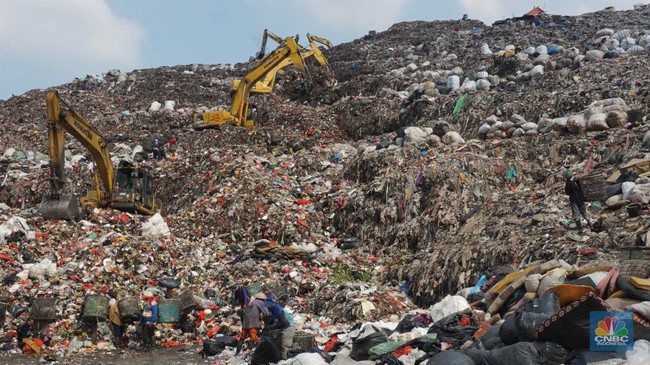
Jakarta, CNBC Indonesia - Coordinating Minister for Food Affairs Zulkifli Hasan has stated that Indonesia is experiencing a waste emergency. Consequently, the government intends to expedite the completion of Waste-to-Electricity (PSEL) projects by 2028.
This was revealed by Zulhas during the Signing of the Joint Agreement between Local Governments and Danantara for the Acceleration of PSEL Development on Monday (11/5/2026).
“The President’s directive is that we cannot become an advanced nation if we cannot even resolve the waste issue, which causes pollution of land, water, and air, threatening public health and safety. What we are discussing today is an emergency category, specifically open dumping,” said Zulhas.
“The accumulated waste has already been categorised as an emergency, sir,” he added.
Waste accumulation in Indonesia has indeed occurred in several regions, such as at the Final Disposal Sites (TPA) in Bantar Gebang (Bekasi), Cipecang (South Tangerang), Burangkeng (Bekasi), and others. Even a few months ago, a landslide of a waste mountain occurred in Bantar Gebang, claiming lives.
“What has been categorised as emergency is 22.5%. The incident in Jakarta last time claimed victims. Other regions also have high accumulations,” said Zulhas.
According to him, Presidential Regulation Number 109/2025 on Urban Waste Management through Waste-to-Renewable Energy Processing Using Environmentally Friendly Technology mandates that the waste issue be resolved by 2028.
Zulhas explained that the regulation covers 25 locations encompassing 62 districts/cities that must be addressed.
“The emergency ones, those above 1,000 tonnes that keep piling up 1,000, 1,000, 1,000 tonnes, that amounts to 22.5%. We will complete the process in 6 months for administration and 2 years for construction,” he said.
“Thus, by 2027 half will be completed, by May 2028 for the 22.5% emergency portion. There is still 77.5%, which includes 500, 600, 700 tonnes. We are currently finalising the regulations to expedite this,” he added.
According to Zulhas, BRIN along with universities in Indonesia already possesses the technology to resolve waste, particularly for production below 1,000 tonnes in various regions. This includes technologies such as RDF (Refuse Derived Fuel), TPST (Integrated Waste Processing Site), and Pyrolysis. Through these methods, he hopes the waste problem can be resolved at each respective area.
“The emergency ones up to 1,000 tonnes, we will resolve in the next two years. The others by 2029,” he said.
“By 2029, we hope that in all provinces, districts, and cities, the waste that can be managed will be resolved. Offices, governor’s offices must resolve their waste. Mayor’s offices, regents’ offices, markets must resolve it there. Schools, restaurants, shops must resolve it there,” he added.