
Zamzam Water Thriving at Tanah Abang Market, Supplied by Cabin Crew
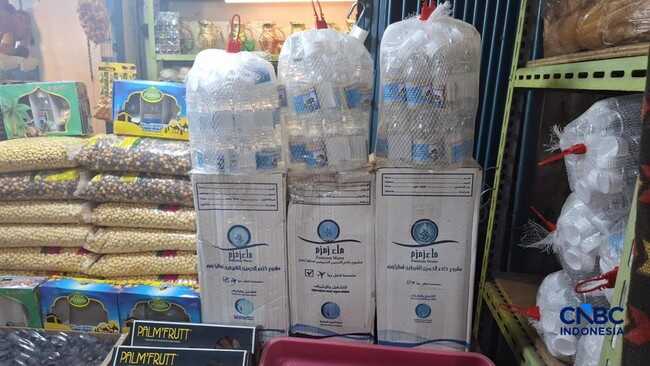
Jakarta, CNBC Indonesia — Sales of Zamzam water at Tanah Abang Market remain brisk despite Saudi Arabia limiting official exports abroad. At various stalls, the sacred water from Mecca is sold freely at prices of hundreds of thousands of rupiahs per gallon.
During a recent survey by CNBC Indonesia, traders revealed diverse supply routes. Some rely on umrah pilgrims, whilst others claimed to obtain supplies from specialised importers and airline cabin crew members.
Prices are not inexpensive. For a five-litre container, traders charge approximately 500,000 rupiahs per gallon, influenced by what are perceived as increasingly stringent distribution channels.
One trader, Riadi, said Zamzam water is typically brought by umrah pilgrims, although there are restrictions when transporting such water.
“Here, the Zamzam water is brought by umrah pilgrims, though with the pilgrimage, it’s difficult with regulations,” Riadi said when met by CNBC Indonesia.
According to him, umrah pilgrims bringing the water are also part of the store’s network. “The umrah pilgrims are shop owners here too, and he often travels to the Holy Land,” Riadi added.
Another trader, Firman, claimed his Zamzam water supply comes from specialised importers and distributors. “The Zamzam water sold here comes from importers, there are specialised importers because now the requirements are quite strict, and you cannot arbitrarily bring Zamzam water,” Firman said.
Through specialised importer channels, retail prices become higher. “Because it goes through specialised importers, the price is expensive, just for this five-litre container it can be 500,000 rupiahs,” he said.
Additionally, some supply is brought by cabin crew members. This occurs because of official restrictions on Zamzam water exports.
“Here it’s brought by cabin crew because if regular people do it, it’s no longer allowed from there,” said Deny.
Deny added that he can obtain around five five-litre gallons daily, though collection occurs fortnightly.
“But we collect every two weeks, so maybe five gallons daily,” he said.