
Z-Auto Baznas East Kalimantan: The rightful way zakat breaks the chain of poverty
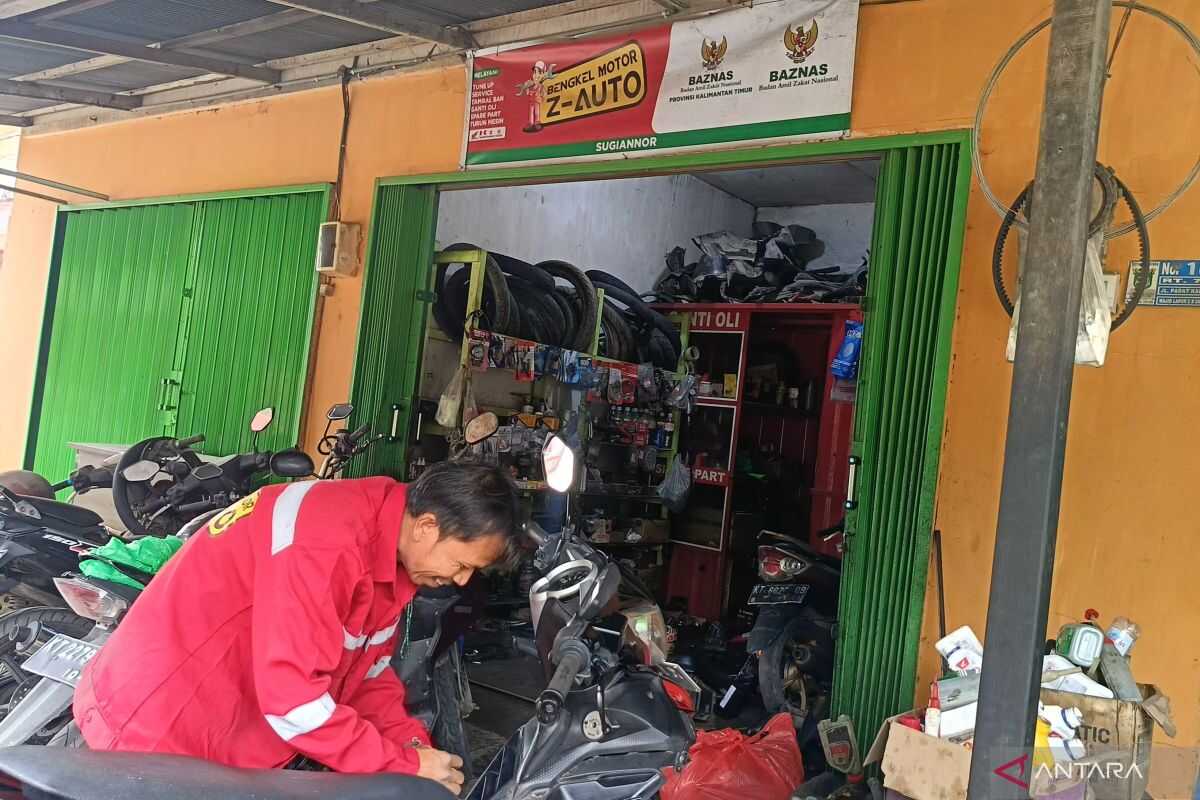
Samarinda — The story of Sugiannor and dozens of other Z-Auto mechanics in East Kalimantan exemplifies how zakat serves as a means to eradicate poverty.
Fortune is unpredictable. Today one may struggle in poverty, yet tomorrow one might ascend to a position of dignity and self-sufficiency. It is not circumstance alone that determines this trajectory, but rather one’s effort, gratitude, and determination to progress. Such a narrative applies to Sugiannor, who once received zakat as a beneficiary (mustahik) and has now elevated to the status of zakat contributor (muzaki).
The story unfolds in a modest workshop in Samarinda, East Kalimantan, where the sound of impact wrenches fills the air. Sugiannor works diligently, removing bolts from mud-covered automatic scooters. The aroma of used engine oil, petrol, and road dust has been his constant companion for over a decade. For him, the workshop is not merely a place to earn a living—it is his means of survival.
He opened his motorcycle repair shop in 2009. Originally from South Kalimantan, he had resided in Samarinda since the 1990s with no formal background in two-wheel automotive mechanics. He spent five years teaching himself through self-study and apprenticeships to master motorcycle engine mechanics.
For over a decade, his workshop’s journey was turbulent. Before 2024, Sugiannor’s shop epitomised a typical micro-enterprise, surviving day-to-day but struggling to grow. His situation was precarious, given his responsibility to support a wife and child. Working alone with manual tools that drained his energy and time, his daily gross income barely reached 300,000 rupiah—sufficient for daily sustenance but insufficient to dream of business expansion or savings for a more secure future.
This changed in 2024 when Baznas East Kalimantan’s productive zakat assistance programme arrived.
Sugiannor was selected as a first-cohort beneficiary of the Z-Auto productive zakat empowerment programme administered by the National Zakat Authority (Baznas) of East Kalimantan Province. This initiative was not a consumptive cash distribution but rather measured, productive capital assistance. Baznas provided 20,000,000 rupiah per workshop in workshop equipment and spare parts.
For Sugiannor, this manifested as completion of operational vehicle documentation and workshop equipment including a large air compressor, infusion tubes for injection cleaning, safety boots, and the impact wrench that has become his primary tool. “The equipment from Baznas has made a tremendous difference. Work that previously required excessive effort and considerable time can now be completed quickly,” he explains.
Time efficiency directly correlates with production capacity. Whereas he previously struggled to handle several motorcycles alone, his workshop now services 10 to 15 motorcycles daily. This capacity increase enabled him to recruit two team members, creating modest employment opportunities in the vicinity.
The economic impact is tangible. His daily turnover has surged to approximately 1,000,000 rupiah over the past two years, including service fees and spare parts sales—representing a transition from vulnerable poverty to economic self-reliance.
From beneficiary to contributor
Baznas East Kalimantan’s chairman, Kyai Haji Ahmad Nabhan, ensures that the zakat funds managed by his institution serve as genuine long-term investments rather than ephemeral charitable gestures. Specifically in East Kalimantan, the programme has intervened with 30 micro and small enterprises distributed across two phases: 10 beneficiaries in 2024, followed by 20 in 2025.
“We do not select arbitrarily. The fundamental criteria are mandatory—they must fall within the zakat-eligible categories such as the destitute, poor, or other deserving groups. Subsequently, they must possess basic competence and, most importantly, a strong commitment to progress. These zakat funds are trusts from the community; they must generate productive returns,” explains Bagas Raga, programme manager for Z-Auto Baznas East Kalimantan.
Baznas’s approach extends beyond capital provision. Intensive on-site mentoring is provided, with regular field visits, open forums for mechanics to raise concerns, and rigorous monthly evaluations. Technical monitoring demonstrates consistent improvement, with average communal revenue growth of 50 to 60 per cent across all Z-Auto beneficiary points.
However, Baznas’s programme success transcends operational metrics. As an institution managing community religious funds, their success criteria incorporate dual dimensions. Beneficiary development is measured not only by technical aspects—turnover and technical skill—but also by non-technical dimensions: moral character and spiritual conduct.
“This is zakat funding, a programme specifically for Muslims. Consequently, we bear a moral responsibility to ensure that their economic stability correlates with their spiritual proximity to the Creator,” states Raga.
Baznas’s evaluation records indicate increased consistency in performing the five daily prayers and Quranic recitation among the mechanics. Those previously too exhausted by struggle with lubricants and machinery to maintain prayer times now exhibit greater life regularity.
The programme’s pinnacle lies in socioeconomic class mobility. Baznas East Kalimantan’s data reveals that 30 per cent of Z-Auto beneficiaries have transitioned from zakat recipients (mustahik) to zakat contributors (muzaki), whilst 70 per cent have become regular voluntary contributors (munfik), exemplifying the programme’s transformative impact.