
Yovie Takes the Stage, JEC Suddenly Becomes a Karaoke Venue
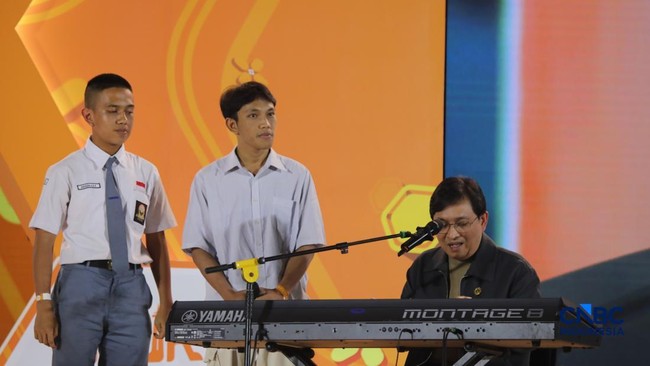
Yogyakarta, CNBC Indonesia - Special Staff to the President for Creative Economy Yovie Widianto successfully turned Jogja Expo Centre (JEC) into a romantic venue. His performance, which touched on soft power, culture, music and artificial intelligence, enlivened the Jogja Financial Festival 2026. Although the topics were serious, Yovie slipped in piano playing and invited the audience to sing along. He performed several of his own compositions, such as ‘Cantik’, ‘Mantan Terindah’ and ‘Soulmate’. Attendees of Jogja FinFest were enchanted by Yovie’s heartwarming songs, and the festival suddenly became a karaoke venue. The festival featured musicians with notable works in Indonesia discussing the large economic potential of creation and copyright for a piece of work. Yovie said that although the creative industry is being challenged by the advent of artificial intelligence (AI), there are fundamental differences. ‘AI can create quickly, but AI does not have a heart,’ he said at JEC on Friday (22 May 2026). In the session, Yovie even demonstrated his ability to compose a song rapidly with participants. By entering random numbers as musical notes, AI is said to be able to form a song in about 60 seconds. Nevertheless, the songwriter of ‘Mantan Terindah’ believes AI should be a helper tool, not the primary foundation in the human creative process. ‘Make AI a tool or partner in our work. But do not become the main tool or rely on AI,’ he urged. Yovie acknowledged that technological advances cannot be avoided. He said he has always followed developments in music technology since the cassette era, analog tape, and digital platforms today. ‘If I do not study technology, I will surely be closed off and fade away with the times,’ he said. In the Musical Talks segment of Jogja Financial Festival 2026, Yovie cited South Korea as a country whose music industry has thrived by adopting a strategy of creative soft power. He highlighted how South Korea has transformed K-pop, film, drama, fashion and games into a national identity as well as the engine of the country’s economy. ‘If well managed, creative works can become national identity, a diplomatic instrument, an engine of the economy, and even a global influence,’ Yovie said. Indonesia, he noted, actually possesses cultural capital no less substantial. Yovie noted that Indonesia has more than 550 cultural nodes from Sabang to Merauke. Differences in culture can even be found within neighbouring regions. ‘South Yogyakarta and North Yogyakarta differ. Sleman and Bantul also have distinct styles,’ he said. Therefore, he believes Indonesian local culture should be developed into high-value creative economy products through technology, branding, storytelling, and digital distribution. ‘Through branding, storytelling, and digital distribution, the value of culture can cross space, time, and markets,’ Yovie concluded.