
Yogyakarta Inter-generational Breaking of Fast Vigil: Sovereign Indonesia. Open Constitutional Struggle
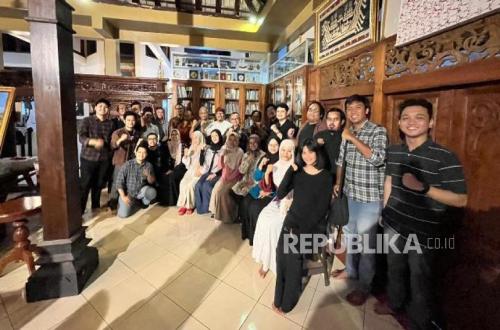
Yogyakarta — The Yogyakarta Sovereign People’s School held an inter-generational discussion vigil on Monday (16 March) attended by approximately 30 academics, activists, and civil society leaders, predominantly young participants.
The response panel included Prof M Baiquni, Chair of the Board of Professors at Universitas Gadjah Mada and host institution, and Sudirman Said, Rector of Universitas Harkat Negeri.
Opening the discussion, Prof Baiquni sounded an alarm: “Our nation is not doing well.” As widely known, on Monday (2 March), alongside several professors and academics from Universitas Gadjah Mada, Prof Baiquni declared a position statement opposing the signing of a bilateral Agreement on Reciprocal Trade (ART) with the United States President. The ART was deemed harmful and threatening to Indonesia’s national sovereignty.
In the “Bulaksumur Thinking” statement, Prof Baiquni emphasised: “Because it was not based on consultation with the House of Representatives and ratification by law, the ART violates the constitution, specifically Article 11 of the 1945 Constitution. It also violates Article 10 of Law 24/2000, Article 84 of Law 7/2014, and Constitutional Court Decision No 13/PUU-XVI/2018. We reject Indonesia’s foreign policy that sides with the aggressor as reflected in the signing of the ART and Indonesia’s participation in the Board of Peace, which harms the sovereignty of the Republic of Indonesia.”
According to Prof Baiquni, the principles of “dignified Indonesia,” “sovereign Indonesia,” and “constitutional Indonesia” must continue to be upheld. “This spirit must be promoted, especially through ‘epistemic markers’ such as what we are holding now,” he stated.
Referencing epistemic markers, Sudirman Said reminded educated citizens of their primary duty: not to remain silent when witnessing deviations. Currently, he noted, Indonesia urgently needs the light of intrinsic leadership. This city once possessed it through Sri Sultan Hamengkubuwono IX with his ethos of “The Throne for the People,” supported by two pillars: discipline and virtue. Without these two, governance becomes reckless. “Rules of state governance are trampled, crushed, or bent according to desires. The risks of recklessness are not distant—they are already here. We are now witnessing or experiencing them directly,” he said.
In agreement, Pinurbo from Forum 245 reinforced that independence is not merely a matter of state status alone; all citizens must also be epistemically free to create balanced governance between state and people.