
Yen-Yuan Fall: Rupiah Crashes Overseas, Dollar Breaches Rp 17,000
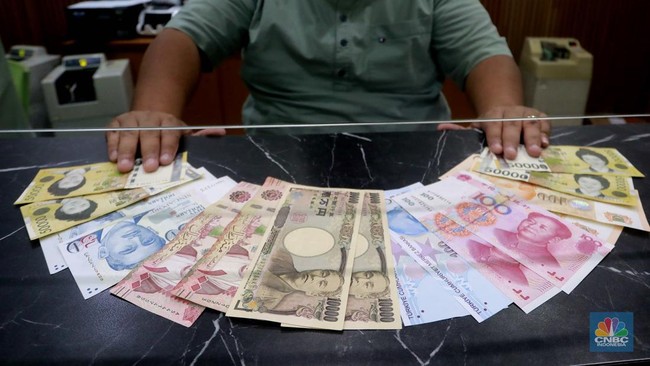
Jakarta, CNBC Indonesia - Movements in Asian currencies collectively weakened against the US dollar on Thursday morning trading (19/3/2026).
Based on Refinitiv data at 08:40 WIB, all monitored Asian currencies were moving in a weakening zone against the US dollar.
The deepest weakening was recorded by the Philippine peso (PHP), which fell 0.66% to PHP 60.192/US.TheThaibaht(THB)followedwithadepreciationof0.49, while the Chinese yuan (CNY) weakened 0.37% to CNY 6.9111/US$.
The Taiwan dollar (TWD) was also noted to drop 0.26% to TWD 32.098/US.Atthesametime, theSouthKoreanwon(KRW)weakened0.20, while the Japanese yen (JPY) fell 0.09% to JPY 159.33/US$.
The Vietnamese dong (VND) depreciated 0.08% to VND 26,308/US, whiletheSingaporedollar(SGD)weakenedslightlyby0.03.
The rupiah today is still not traded in the spot market due to the post-Eid holiday. However, the direction of the rupiah’s movement can still be observed from the non-deliverable forward (NDF) market.
Based on Thursday (19/3/2026) rupiah NDF contract data, short-term tenors show the rupiah still at a relatively weak level. For the one-month tenor, the NDF outright bid was recorded at Rp17,004/US$ and the ask at Rp17,015/US$.
Such caution is inseparable from the US dollar’s generally strong position. The US dollar index (DXY) at the same time was still moving above the 99.5 level, in line with increasing demand for safe-haven assets amid escalating geopolitical tensions in the Middle East.
The US-Israel war against Iran has now entered its fourth week and shows no signs of abating.
US President Donald Trump has even threatened to attack Iran’s power generation facilities if the Strait of Hormuz is not reopened. On the other hand, Tehran has warned of targeting key US and Israeli assets in the region if its energy facilities are attacked.
This situation is also driving oil prices to remain high, thereby triggering concerns that global inflation will rise again. That situation is also making the chances of interest rate cuts by the Federal Reserve (The Fed) in the near term increasingly slim.
In fact, some market participants are beginning to open the possibility of a rate hike by year-end.
At last week’s meeting, The Fed did hold its benchmark interest rate in line with market expectations.
Fed Chair Jerome Powell stated it is still too early to assess the full impact of the Iran conflict on the economy. A similar stance was taken by other major central banks such as the European Central Bank (ECB), Bank of England (BOE), and Bank of Japan (BOJ), which also held interest rates but remained ready to tighten policy if inflationary pressures persist.