
Yen, Yuan, and Rupiah Plunge Amid Anxiety Over 'Terrifying' US Meeting
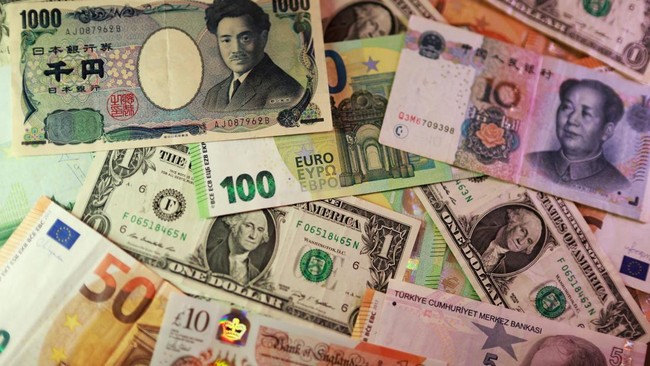
Jakarta, CNBC Indonesia - The majority of Asian currencies weakened against the US dollar on Tuesday’s trading (28/4/2026). Pressure mounted alongside the strengthening of the US dollar index or DXY ahead of the important agenda of the US central bank (The Federal Reserve/The Fed).
According to Refinitiv data at 09:15 WIB, the rupiah weakened 0.29% to Rp17,235/US$. This decline positioned the rupiah as one of the Asian currencies under significant pressure this morning.
The Thai baht recorded the deepest weakening in Asia, dropping 0.31% to THB 32.42/US.Followingthat, thePhilippinepesoweakened0.14, the Taiwan dollar fell 0.11% to TWD 31.49/US, andtheChineseyuanweakened0.09.
The Korean won also corrected 0.04% to KRW 1,474.62/US, theSingaporedollarweakenedslightlyby0.02, while the Japanese yen dropped 0.05% to JPY 159.5/US$.
On the other hand, only a small portion of Asian currencies managed to hold in positive territory. The Vietnamese dong strengthened 0.09% to VND 26,326/US, whiletheMalaysianringgitroseslightlyby0.03.
Pressure on Asian currencies occurred as the US dollar strengthened again in global markets. The US dollar index (DXY) at 09:15 WIB was observed rising 0.07% to 98.562.
Today’s US dollar movements were heavily influenced by market participants’ stance as they awaited the outcome of the Fed meeting. The Fed’s policymaking committee, or Federal Open Market Committee (FOMC), will hold a meeting on Wednesday local time and is expected to maintain interest rates.
Although the interest rate decision is anticipated to remain unchanged, market attention will focus on the Fed’s statement regarding the US economic conditions. Investors want to see whether the US central bank is becoming more optimistic about the economy or remains concerned about inflation that has not declined rapidly.
Quoted from Reuters, Steve Englander, global head of G10 FX research at Standard Chartered in New York, assessed that this meeting is not primarily focused on interest rate changes. However, the Fed’s assessment of the economy could potentially improve.
He also noted that inflation is still improving very slowly and could become a key issue for Kevin Warsh when he later assumes office.
This week’s Fed agenda is also noteworthy because the meeting is likely to be Jerome Powell’s last as Fed Chair. This follows Republican Senator Thom Tillis withdrawing his objection to Kevin Warsh’s confirmation process on Sunday.
The US Senate Banking Committee is also expected to advance Warsh’s nomination as Fed Chair to the full Senate session. The vote is scheduled for Wednesday morning US time.
In addition to the Fed factor, markets are still monitoring developments in the Iran war.
The majority of global currencies tended to move within narrow ranges as investors awaited new signs regarding the chances of the war ending.
US President Donald Trump on Monday discussed Iran’s new proposal to resolve the war with his national security advisers.
However, a US official later stated that Trump was not satisfied with the proposal because it did not address Iran’s nuclear programme.
This situation keeps markets cautious. As long as the direction of Fed policy remains unclear and the Iran war shows no signs of resolution, the US dollar remains poised to be the primary determinant of Asian currency movements, including the rupiah.