
Years of Skipping Work, Social Ministry ASN Finally Dismissed
Social Minister (Mensos) Saifullah Yusuf has officially announced the dismissal of one civil servant (PNS) within the Ministry of Social Affairs (Kemensos) and three companions of the Family Hope Programme (PKH) holding PPPK status for committing serious disciplinary violations.
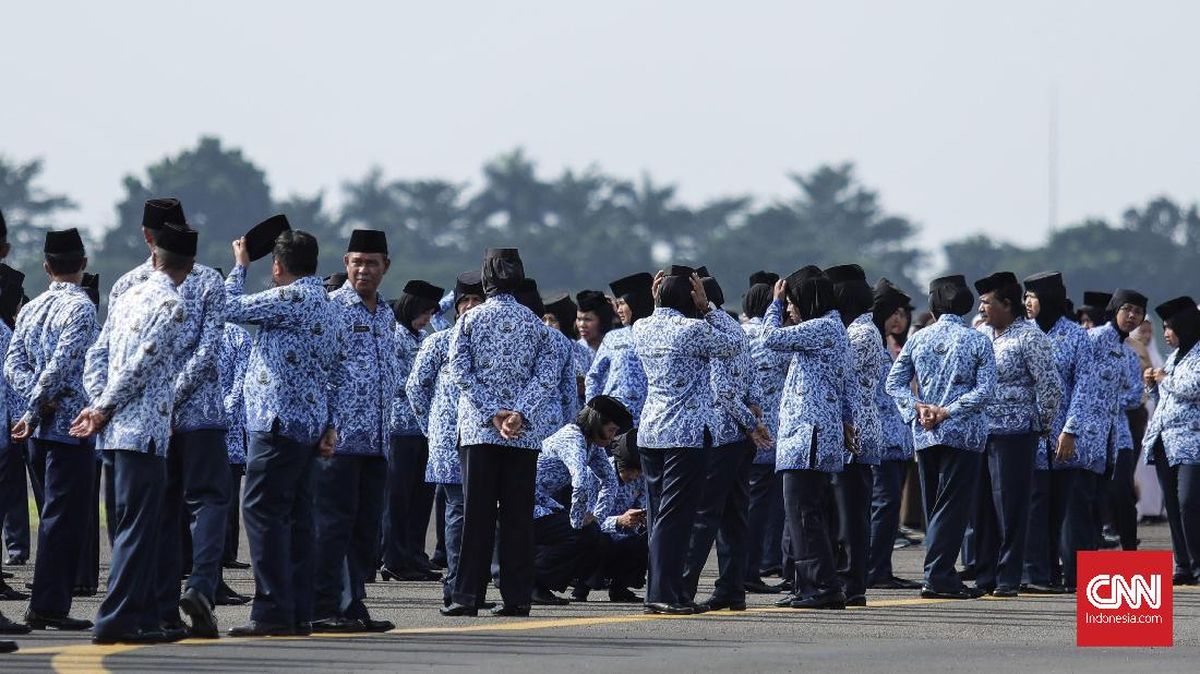
The announcement of the dismissal was delivered directly by Saifullah following the disciplinary roll call for employees at the Ministry of Social Affairs office on Thursday morning (26/3).
“Today, I signed the dismissal for one ASN. He has met the criteria for dismissal because for the past several years, he has never shown up and has not carried out his duties properly,” he said, met with silence by the hundreds of roll call participants who did not expect a dismissal.
In addition to that PNS, Saifullah also announced the dismissal of three PKH companion staff holding Government Employee with Work Agreement (PPPK) status.
Saifullah emphasised that this firm action is a continuation of last year’s disciplinary evaluation, in which nearly 500 employees received Warning Letter (SP) 1 and SP 2, with 49 of them ending in dismissal.
Currently, Kemensos is also processing several other employees suspected of serious violations.
Saifullah assured that the sanction process will continue for anyone who does not meet the established integrity and performance criteria.
“There are several more who have also committed serious violations that we are processing. We will not hesitate to discipline undisciplined employees to ensure public services remain maintained,” he stressed.
Thousands of employees skip work after Eid
In the disciplinary guidance roll call for employees, Saifullah revealed that as many as 2,708 Kemensos employees across Indonesia were monitored as not reporting to work without explanation on the first day after the Eid al-Fitr 1447 Hijriah holiday, Wednesday (25/3).
Of that number, 156 employees are stationed at the central office, halls, and service centres of the Ministry of Social Affairs, while the other 2,500 employees were recorded as committing disciplinary violations, including among them the PKH Programme Companions.
“I am saddened that some of these undisciplined PKH companions were only recently appointed and have not even served for a full year as government employees,” he said.
Saifullah recalled that last year, he had issued stern warnings to 500 PKH companions, 49 of whom ended in dismissal. Entering 2026, firm action in the form of dismissal has also been imposed on three P3K PKH companions due to similar issues.
“In the future, we will not hesitate to dismiss problematic and undisciplined P3K or PNS. This is not a small or trivial number, and such actions harm the institution,” he said, in response to the many employees who skipped on the first working day while there are many public service tasks that must be completed, such as social assistance programmes and social-economic recovery assistance for natural disaster victims.
According to him, unexcused absence is a form of ASN disciplinary violation that harms the obligation to demonstrate integrity and exemplary conduct. This is as regulated in Government Regulation (PP) Number 94 of 2021 on Civil Servant Discipline.
Sanctions will be imposed according to the level of violation, ranging from light, moderate, to severe disciplinary punishments. “For the light category, sanctions can include verbal reprimands, written reprimands, or written statements of dissatisfaction from the leadership,” he stated.
In addition to administrative sanctions, violating employees are also threatened with financial sanctions in the form of deductions from performance allowances (tukin).
In accordance with Minister of Social Affairs Regulation Number 6 of 2023, employees who do not record their attendance when entering or leaving work will be subject to a 3 percent tukin deduction per day.
“Do not waste the opportunity to serve the state; remember there are many people queuing to become ASN or P3K. Also, remember that we are all monitored by state institutions and the public, of course,” he remarked.