
Yaqut's Legal Team Claims Regulatory Inconsistency in Suspect Designation Process
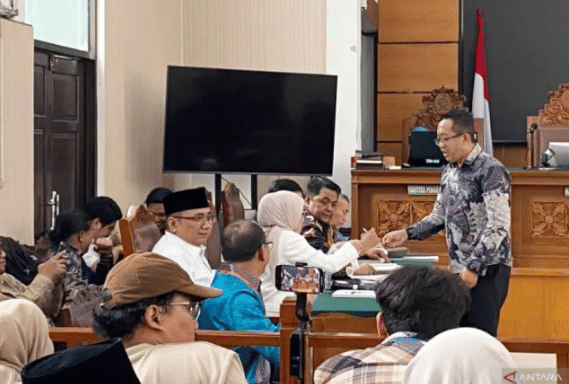
The legal team representing former Minister of Religious Affairs Yaqut Cholil Qoumas has concluded that the corruption investigation by the Corruption Eradication Commission (KPK) against their client should comply with the provisions of the new Criminal Procedure Code (KUHAP). This argument is based on the fact that the suspect designation occurred after the new regulations came into effect officially.
In their written submissions, Yaqut’s legal team explained that his designation as a suspect in the hajj quota case was based on an Investigation Order (Sprindik) dated 8 January 2026, whereas the new KUHAP and Criminal Code (KUHP) became effective from 2 January 2026.
According to Yaqut’s legal team, investigation orders issued before 2 January 2026 (specifically on 8 August 2025 and 21 November 2025) were general investigation orders at the evidence-gathering stage.
“This means that for the petitioner, specific investigative proceedings commenced only after the new KUHAP became effective, and therefore the provisions that must be adhered to are Article 361(b) of the new KUHAP as a transitional provision, which must be read as a unified whole with Article 3 and Articles 618 and 622 of the new KUHP,” the legal team stated in documents submitted to the pre-trial judge at the South Jakarta District Court on Monday (9 March).
The petitioner’s team identified inconsistencies in the application of regulations, highlighting the reference to Articles 2(1) and 3 of the Anti-Corruption Law and Article 55 of the old Criminal Code in the suspect designation notification letter.
“Yet at the same time, the KPK employed a mechanism known in the new legal regime, namely the Suspect Designation Notification Letter,” the defence counsel stated.
“Accordingly, the problem is not merely that the respondent used provisions that have been repealed, but also that the respondent has conflated two different legal regimes in a single suspect designation action,” they added.
Beyond the regulatory issues, Yaqut’s legal team concluded that his right to self-defence was not respected because he was never interrogated in his capacity as a prospective suspect.
“Yet according to expert evidence presented in court, interrogation of a person as a prospective suspect is an important part of the investigative process sequence that ensures the implementation of due process of law,” the defence counsel noted.
Furthermore, the legal team argued that the suspect designation failed to satisfy the requirement of two pieces of evidence, particularly regarding the calculation of state losses. This argument references Constitutional Court Decision No. 25/PUU-XIV/2016, which determined that Articles 2(1) and 3 of the Anti-Corruption Law constitute material crimes. In their view, proof of state loss must be based on investigative forensic audit for justice purposes.
The South Jakarta District Court is scheduled to deliver its pre-trial ruling on the case brought by former Minister of Religious Affairs Yaqut Cholil Qoumas on Wednesday (11 March).