
Xi Jinping-Trump Meeting: Face-to-Face between the World's "Debt Kings"
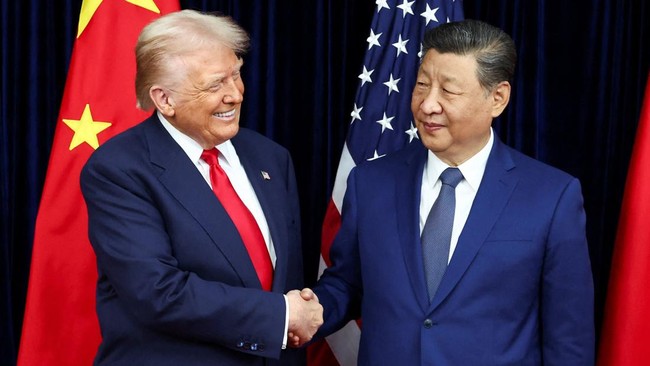
The meeting between United States President Donald Trump and Chinese President Xi Jinping in Beijing this week will be a key agenda item in the relations between the world’s two largest economies.
Behind discussions on the trade war, technology, Taiwan, and the Iran conflict, this meeting also brings together two countries with the largest government debt burdens in the world.
Trump is scheduled to arrive in Beijing, China, on Wednesday local time, ahead of talks with Xi Jinping on 14-15 May 2026.
This visit marks Trump’s first trip to China in nearly a decade. His last visit to China was in 2017, during his first term as US President.
At that time, China hosted Trump for an official state visit at Xi Jinping’s invitation.
Thus, this visit to China becomes Trump’s second as US President. However, this meeting occurs in a far more complicated global atmosphere.
In 2017, US-China relations were still framed largely by opportunities for economic cooperation, although trade issues were beginning to heat up.
Now, relations between the two countries have evolved into far more complex rivalry, ranging from the trade war, technology restrictions, artificial intelligence (AI) competition, to geopolitical influence in the Indo-Pacific region.
The Trump-Xi meeting will also take place amid efforts by both countries to maintain trade relations stability. The US seeks to promote purchases of agricultural products and aircraft, while issues such as chips, market access, and China’s relations with Iran are among the main concerns.
However, behind this diplomatic and economic agenda, there is another equally intriguing fact. Trump and Xi not only represent the world’s two largest economies. They also lead two countries with the world’s largest government debt burdens.
US and China Government Debt Showdown
In 2025, US government debt was recorded at US$38.3 trillion. This figure is still far larger than China’s at US$18.7 trillion. Thus, US government debt remains more than double that of China.
The difference between them is around US$19.6 trillion.
With this position, the US remains the country with the largest government debt in the world. However, China is catching up rapidly because its debt increase over the past two decades has been far more aggressive.
In 2008, US government debt was at US$10.9 trillion. By 2025, the figure has surged to US$38.3 trillion. Thus, since the 2008 global financial crisis, US government debt has increased by around US$27.4 trillion.
Meanwhile, China’s government debt in 2008 was only US$1.2 trillion. But by 2025, it has already surged to US$18.7 trillion.
In other words, China’s government debt has increased by around US$17.5 trillion in just 17 years.
China’s Debt Grows Faster
Looking at the growth rate, China’s debt increase is far faster than that of the US.
Since 2008, China’s government debt has grown at around 17% per year. This rate is more than double that of the US, which grew at around 7.7% per year over the same period.
China’s debt surge is inseparable from massive credit expansion, infrastructure spending, and an economic growth model largely supported by the state.
For years, the Chinese government has relied on infrastructure development, local government financing, and credit support to keep economic growth high.
This strategy has successfully supported China’s economic expansion. However, on the other hand, the government debt burden has also risen sharply.
The US debt increase itself has been driven by large fiscal spending, tax cuts, economic stimulus, and continuously widening deficit financing.
This pressure has intensified since the 2020 pandemic, when the US government rolled out massive stimulus to support households, businesses, and financial markets.
Not Just Nominal, Debt Ratios Are Also Similarly Large
Based on the Global Debt Monitor report for Q4-2025 released by the Institute of International Finance (IIF), the debt burdens of the United States and China are both substantial when viewed as percentages of gross domestic product (GDP).
The United States has household debt at 68% of GDP, non-financial corporate debt at 73%, and government debt at 123%, resulting in total debt of 264% of GDP.
Meanwhile, China has household debt at 60% of GDP, non-financial corporate debt at 142%, and government debt at 97%, resulting in total debt of 298% of GDP.
From the composition, the US government debt burden is larger than China’s. However, China’s total debt is higher due to the large non-financial corporate debt, which reaches 142% of GDP.
For the global economy, this situation is important to monitor. Large debt burdens can influence interest rate directions, fiscal policies, investor confidence, and global financial market stability.
In other words, the Trump-Xi meeting is not just a meeting between two superpower leaders. It is also a meeting between the world’s two largest debtors who must both maintain economic growth amid ever-increasing debt burdens.