
World Water Day: Pertamina's Trail of Care from the Remotest Parts of Papua to Disaster-Affected Areas
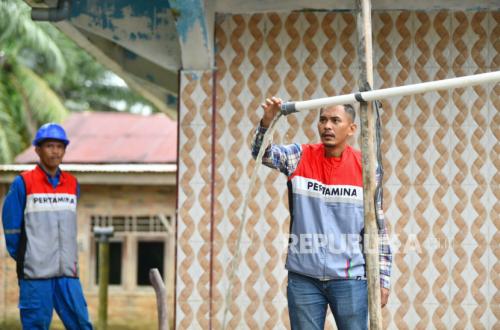
REPUBLIKA.CO.ID, JAKARTA - For years, thousands of residents in Tambat Village in Merauke, Papua, had to rely on the mercy of the skies to sustain their lives. When clouds failed to appear, they were forced to use manual wells with water that smelled of sulphur. This was a difficult choice between thirst and health risks.
Samuel Heremba, the head of Tambat Village, recalls those tough times. “In the past, we heavily relied on rainwater collection. There was a well, but the water contained sulphur and was not safe for use,” said Samuel.
However, those worries have now dissipated. Through its Social and Environmental Responsibility (TJSL) programme, PT Pertamina (Persero) has introduced a complete borehole system equipped with a storage reservoir and filtration facilities. Its arrival was eagerly anticipated. Even before the official inauguration ceremony, villagers flocked with their jerry cans.
“Now the community no longer worries about sulphur content or water shortages during the dry season. The water is much cleaner, and the storage is more than sufficient,” said Samuel with a gleam of gratitude.
Marking World Water Day on 22 March 2026, Pertamina’s Vice President of Corporate Communication, Muhammad Baron, stated that in early 2026, the company has built seven borehole points equipped with filter facilities and distribution pipes in Merauke and Jayapura. These facilities now serve 4,585 individuals who previously struggled to access potable water.
“For Pertamina, this clean water initiative is not merely about physical infrastructure development, but an effort to uphold human dignity in the most needy areas. This programme serves as a bridge of hope so that residents in remote Papua and disaster survivors in Sumatra can begin to rebuild their lives decently,” said Baron.
A similar story, though wrapped in different sorrow, is experienced by disaster survivors in Sumatra. There, floods and mudslides temporarily cut off access to clean water, leaving despair for residents like Putera. He described the water filtered from ditches as ‘cappuccino water’ due to its thick brown colour.
Responding to the emergency conditions, Pertamina quickly built 25 new wells. Pertamina also reactivated 43 community wells that were affected, and distributed 5 million litres of water via tanker trucks. This step became a new breath for more than 17,000 beneficiaries in the disaster areas.
“This clean water is very helpful. Previously, we used ditch water. As soon as this water aid arrived about two weeks after the incident, we were truly assisted,” said Yanti, one of the Sumatra disaster survivors.
This clean water facility provision programme is Pertamina’s concrete step in supporting the achievement of the Sustainable Development Goals (SDGs). Its main focus is on SDG 6 (Clean Water and Sanitation), strengthened by contributions to SDG 11 (Sustainable Cities and Communities) and SDG 13 (Climate Action) through enhancing community resilience to disasters and droughts.
For residents in Merauke, Jayapura, and survivors in Sumatra, every drop of clear flowing water is tangible proof that Pertamina’s care is present, serving wholeheartedly right up to their doorsteps.