
World Shocked! Silver Price Collapses, Falls More Sharply Than Gold
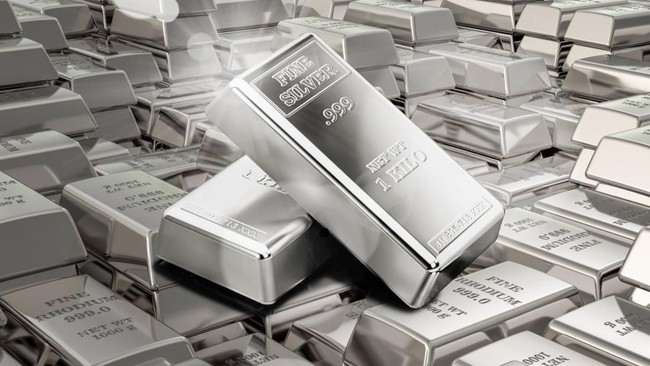
Jakarta – Precious metal prices have moved downward, with silver collapsing at a rate far exceeding gold.
According to Refinitiv, gold closed at US$5,175.45 per troy ounce, strengthening by 0.31% during Wednesday’s (11 March 2026) trading. This weakness contrasts with a 1.06% gain on Tuesday.
On Thursday (12 March 2026) at 14:33 WIB, gold was trading at US$5,169.07 per troy ounce, declining 0.12%.
Since the Iran versus Israel-United States conflict erupted on 28 February 2026, gold prices have fallen 2.05%.
Whilst gold declined only modestly, silver prices have fallen considerably more sharply. Silver dropped nearly 3% intraday, demonstrating its higher volatility compared to gold.
According to Refinitiv, silver closed at US$86.32 per troy ounce, plummeting 2.35% during Wednesday’s (11 March 2026) trading.
On Thursday (12 March 2026) at 14:35 WIB, silver was trading at US$86.44 per troy ounce, rising 0.76%. Since the conflict erupted, silver prices have fallen 7.4%.
The decline affected both major assets, with gold and silver prices falling. However, the magnitude of correction differs significantly.
Silver often moves more wildly than gold. When market sentiment shifts, this metal can fall far deeper than gold.
This occurs because silver possesses unique characteristics: beyond being a precious metal, silver is also an industrial commodity widely used across various manufacturing sectors. This dual role makes silver prices extremely sensitive to changes in global economic and financial market conditions.
The silver market is also smaller and dominated by speculative activity. Consequently, when selling pressure emerges, silver prices can fall faster and deeper.
According to The Economic Times, the difference in decline stems from the market structure of both metals. Initial pressure originated from shifts in global capital flows.
Investors have redirected portfolios towards the United States dollar and government bonds as yields approached 4%. This shift reduced interest in non-interest-bearing assets, including gold and silver.
When the dollar strengthens, silver becomes relatively more expensive for buyers in other countries. This condition potentially depresses global demand and ultimately triggers price corrections.
The dollar index surged to level 99 following the Iranian conflict.
However, the most severe blow to silver originated from the derivatives market. The CME Exchange increased margin requirements for silver futures contracts by 36%. The margin increase forces traders holding high-leverage positions to provide additional collateral.
Many market participants chose to close positions quickly. These liquidation actions triggered selling pressure far more severe on silver than gold.
From a previous price dynamics perspective, silver’s position is indeed more vulnerable to corrections. This metal surged to nearly US$90 per ounce during a strong rally since the start of the year. The rapid increase opened room for profit-taking when macroeconomic sentiment shifted. Gold faced a different situation because its movement remained more stable and still held near historic peak levels.
Changes in monetary policy expectations also reinforced pressure across the entire metals complex. Markets began assessing that high interest rates in the United States would persist longer. This condition increased the attractiveness of the dollar and government bonds. Precious metals lost some support as neither offers yield.
Price movements in other industrial metals show the same pattern. Platinum fell approximately US$51 towards the US$2,183 per ounce range, whilst copper moved weakly around US$5.86 per pound.
The primary pressure originated from global macroeconomic factors, not from fundamental changes in individual commodities.
Nevertheless, the long-term outlook for silver has not changed drastically.
Industrial demand remains strong. The solar energy sector and artificial intelligence infrastructure require this metal in large quantities.
This suggests the correction occurring now reflects market adjustment following a sharp rally and changes in global liquidity.
Gold maintains its role as a store of value when geopolitical uncertainty increases. Silver moves more sensitively to trading dynamics and derivatives market structure. When liquidity pressure emerges, silver volatility tends to be far greater than gold.
Unlike gold, which functions primarily as a hedging asset, approximately 50–60% of silver demand originates from the industrial sector, making industrial demand highly determinative.