
World Faces Instant Paralysis as China's Actions Spark Alarm
Jakarta, CNBC Indonesia - The situation in the Middle East is tense following US and Israel strikes on Iran on 28 February. Iran subsequently launched retaliatory attacks on several US military bases in the region. The escalation has also caused internet outages in Iran. Some analysts say cyber attacks could be responsible for the outages, in addition to disconnections by the regime or the direct impact of strikes on infrastructure.
Banks in the United States have issued warnings to brace for cyber attacks from Iran. In any new conflict, the digital realm is a target.
Beyond the turmoil in the Middle East, it is important to note that the world’s communications network is supported, in part, by submarine cables. It is therefore vital to safeguard this infrastructure from a range of threats.
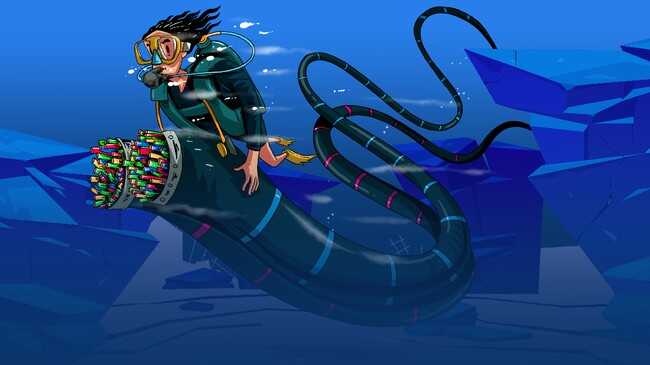
A few moments ago, China was reported to possess a new ‘weapon’—an advanced cutting device capable of severing undersea cables. The device was developed by China’s Centre for Ship Scientific Research (CSSRC).
The tool can target submarine cables that underpin 95% of global data transmission. Undersea cables are made of durable materials such as steel, rubber, and polymers and are thick.
Undersea cables are crucial for the continuity of global communications and energy infrastructure worldwide. However, the cutting device is said to be able to cut them easily.
The China cutting tool can sever lines at depths of up to 4,000 metres, or twice the depth of existing underwater communication infrastructure. The device is designed to be integrated with China’s manned and unmanned submarines, including the Fendouzhe (Striver) and Haidou series.
Originally, the cutting device was developed for civilian rescue and underwater mining. However, concerns have grown about potential dual use for cutting undersea cables.
For instance, cutting cables near strategic chokepoints such as Guam could disrupt global communications, signalling a geopolitical crisis, according to a report by the South China Morning Post.
The underwater cables near Guam are important for the defence of the US island chain.
Design success overcame significant technical challenges posed by underwater conditions, according to a team led by engineer Hu Haolong.
At a depth of 4,000 metres, where water pressure exceeds 400 atmospheres, the titanium alloy hull and oil-compensated seals prevent detonation, even with long-term use.
The weapon is made from diamond
The blade wheel, a 150 mm (six-inch) diamond-coated wheel, rotates at 1,600 rpm, delivering enough power to crush steel while minimising disturbance to seabed sediment.
Designed for submarines with limited power, the tool is fitted with a one-kilowatt motor and an 8:1 gearbox. While efficient, long-term use can lead to overheating.
The device is operated by robotic arms within near-zero line of sight. It is also equipped with advanced positioning technology to ensure precise alignment.
Proof of China’s Strength
The launch of this device marks a significant step as China expands its presence in underwater infrastructure. Beijing now operates the world’s largest fleet of manned and unmanned submarines, with the ability to access all parts of the world’s oceans.
The new cutting tool, which can be operated from an unmanned platform concealed from surface, has the potential to exploit strategic chokepoints without surfacing.
This capability has sparked ongoing discussions among military researchers, particularly after the destruction of Russia’s gas pipelines on the seabed during its war with Ukraine by unknown actors.
However, Chinese scientists insist that the device, which has successfully cut a cable 60 mm thick in land tests, is designed to support the ‘development of marine resources’.
As nations increasingly turn to exploiting ocean resources, the breakthrough could enable China to advance its blue economy and bolster its status as a major maritime power, with a view to achieving long-term national goals, according to scientists.
Earlier, construction of a ‘space station’ at a depth of 2,000 metres on the seabed of the South China Sea began, designed to accommodate at least six people for a month.