
World Bank Highlights MSCI Policy Impact on Indonesian Stocks, Weakening the Rupiah!
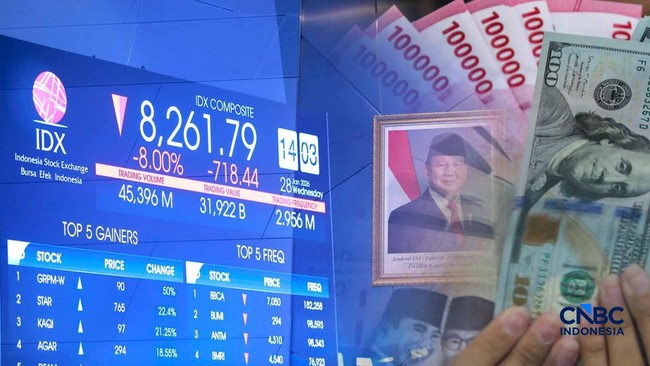
Jakarta, CNBC Indonesia - The World Bank forecasts that Indonesia’s economic growth will slow to 4.7% in 2026. This figure is lower than the previous projection of 4.8% and below the government’s target in the 2026 State Revenue and Expenditure Budget (APBN) of 5.4%.
Citing the latest East Asia & Pacific Economic Update report, April 2026 edition, the downward revision in Indonesia’s economic growth projection is driven by the impact of escalating conflict in the Middle East, namely Iran, which has also pushed up global energy prices.
“Indonesia’s economic growth is projected to slow to 4.7% as pressures from higher oil prices and risk-averse sentiment will only be partially offset by commodity receipts and government investment initiatives,” states the World Bank report, quoted on Thursday (9/4/2026).
Beyond the shocks from the war, the World Bank sees pressure on the rupiah. The main cause, according to the World Bank, is the policy of Morgan Stanley Capital International (MSCI) which has frozen Indonesian stocks from its index.
“Conversely, the Indonesian rupiah depreciated by around 4%, pressured by market concerns over fiscal policy and capital outflows triggered by MSCI’s decision to freeze Indonesian securities in its indices, which prompted Bank Indonesia to intervene,” said the World Bank in its report.
In addition, the World Bank also emphasises challenges from food inflation in the country, which has risen to 3.5%. This is triggered by poor domestic weather.
The World Bank argues that economic growth in China and Indonesia remains relatively high, but measures to maintain current growth may not be conducive to future growth.
“Reforms, such as addressing non-tariff barriers, particularly in the services sector, as well as deregulation and simplification of business licensing (in Indonesia’s case), can enhance growth potential and productive job creation,” said the World Bank in its report.
Regarding MSCI, the Chief Executive Supervisor of Capital Markets, Financial Derivatives, and Carbon Exchange of the Financial Services Authority (OJK), Hasan Fawzi, stated that OJK and the Indonesia Stock Exchange (BEI) are preparing risk mitigation measures if the Composite Stock Price Index (IHSG) falls due to MSCI.
Hasan urged investors not to react reactively if there is a decrease in index weighting. He admitted that the ongoing capital market reforms will have short-term impacts.
“This may involve portfolio adjustments by domestic or global investors, which could trigger temporary selling pressure, as well as potential outflows during rebalancing, followed by volatility and widening bid-ask spreads on certain stocks,” said Hasan during a virtual press conference on Monday (6/4/2026).
However, Hasan stated that such dynamics are transitional and temporary responses. They are part of unavoidable progress. The main focus of capital market regulators is to build a foundation of market integrity that is transparent, credible, and consistently growing.