
World Bank assesses US tariffs' impact on Indonesia's exports as relatively small
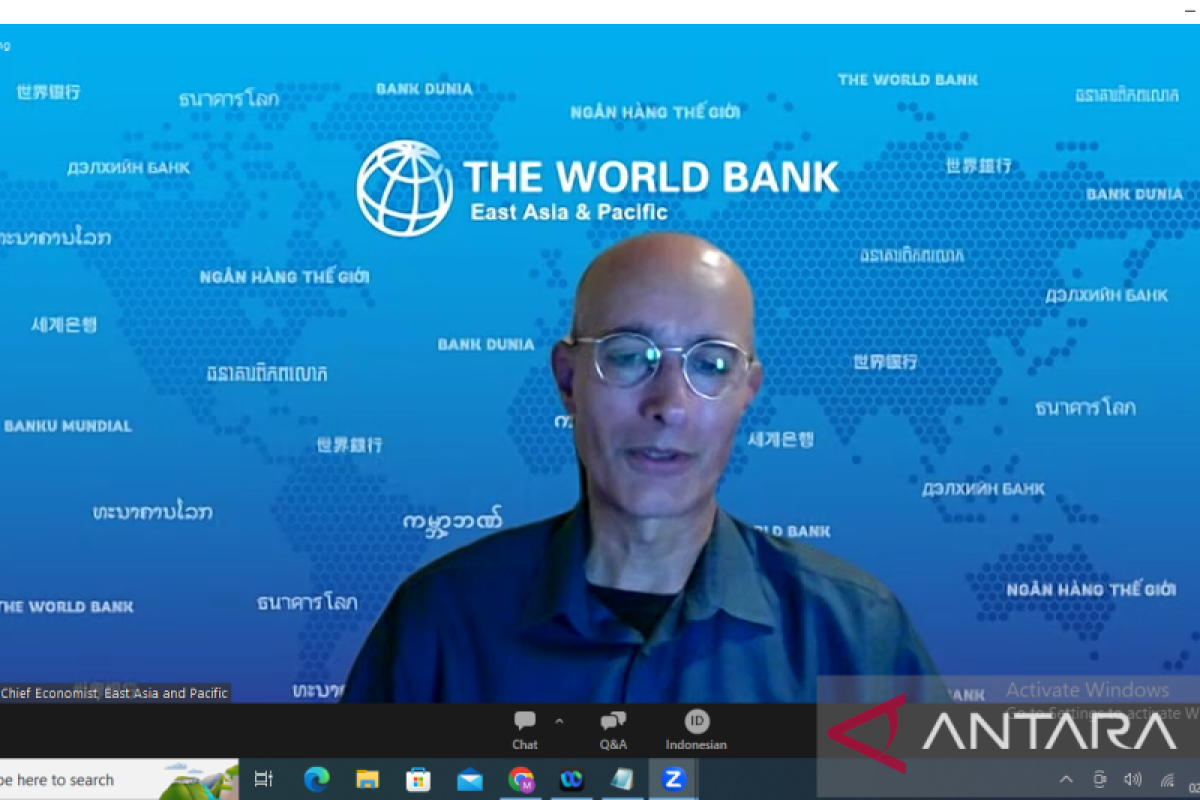
Jakarta (ANTARA) - The World Bank assesses that the impact of US global policies, including tariff policies, on Indonesia’s export performance is relatively limited.
Aaditya Mattoo, the World Bank’s Chief Economist for East Asia and the Pacific, explained that the total tariffs currently faced by Indonesia remain below 20 percent, comparable to Vietnam, though slightly higher than Malaysia and Thailand.
“When calculated through a model, the impact (of US tariffs) on Indonesia’s real income is only around 0.2 percent, thus not causing a significant negative impact on GDP,” he stated in an online interview with ANTARA from Jakarta on Wednesday.
He added that the World Bank’s study in the April 2026 edition of the East Asia and Pacific Economic Update shows that the negative effects of US tariffs can be mitigated through domestic trade policy reforms.
Indonesia is said to still impose many non-tariff barriers, such as import regulations for raw materials and strict technical standards.
“If Indonesia undertakes reforms to reduce non-tariff barriers on goods and services, the benefits from those reforms will far outweigh the costs resulting from US tariffs. In that way, the negative impact of tariffs can be erased,” Mattoo said.
He emphasised that through domestic policies, Indonesia can treat US tariffs as a minor issue because the benefits of domestic reforms will far surpass the costs of those tariff policies.
Previously, on 19 February, Indonesia and the US had agreed on a reciprocal trade deal during a meeting between Indonesian President Prabowo Subianto and US President Donald Trump in Washington, DC.
That agreement is contained in the Agreement on Reciprocal Trade (ART) document, which has been officially signed by both heads of state.
In general, the US applies an average tariff of 19 percent on products originating from Indonesia. However, the US government provides special exemptions for certain identified products that receive a 0 percent tariff.
In return, Indonesia has eliminated tariffs on 99 percent of products originating from the US.
The World Bank report notes that these reciprocal tariffs were subsequently replaced with a global tariff of 10 percent imposed under Section 122 of the Trade Act of 1974. This tariff is temporary and applies until July 2026.
The Central Statistics Agency (BPS) recorded Indonesia’s export value for January–December 2025 at $282.91 billion, up 6.15 percent from the same period in 2024.
Of that amount, non-oil and gas exports reached $269.84 billion, or an increase of 7.66 percent.
The US is the second-largest export destination country with a value of $30.96 billion, after China at $64.82 billion. Non-oil and gas exports to the US were recorded at $4,420.2 million, up 16.66 percent from the previous year.
Meanwhile, Indonesia’s import value for the January–December 2025 period reached $241.86 billion, up 2.83 percent from the previous year. Non-oil and gas imports also rose 5.11 percent to $209.09 billion.
The US ranks third as a supplier of imported goods with a value of $9.84 billion, or 4.70 percent of total imports.