
Workers in the Whirlwind of Global Supply Chains
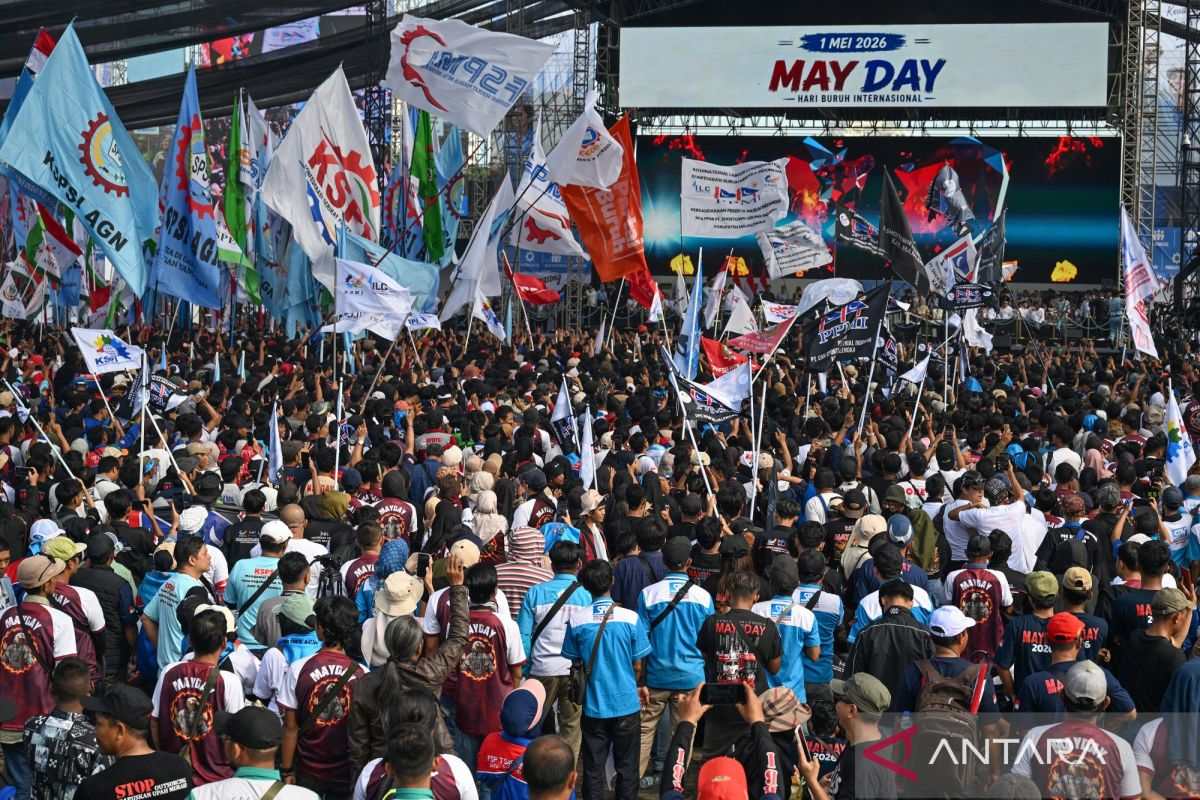
Jakarta (ANTARA) - Every Labour Day on 1 May, we return to a ritual that is almost always the same. Labour actions almost always revolve around demands for wage increases, work protection, and worker welfare.
There is one question that is rarely discussed seriously in our public debates. To what extent is the fate of Indonesian workers truly determined domestically? Or could it be that the reality faced by workers today is more determined by global economic dynamics beyond the reach of the state?
This question is important. Because without understanding it, we risk continuously offering partial solutions to the various problems faced by workers.
In the contemporary economic landscape, Indonesian workers certainly do not stand alone. They are connected within what is known as global production networks, namely global supply chains that link raw materials, labour, capital, and markets in a cross-border system.
A pair of shoes produced in Tangerang, for example, could be designed in Europe, use materials from East Asia, and be sold in the United States. In such a system, the position of Indonesian workers is often at the very bottom, merely as cheap labour.
Workers’ wages in Indonesia are not solely determined by government policies or negotiations between trade unions and employers, but also by Indonesia’s position in the global production chain.
This logic aligns with the world-systems theory approach developed by Immanuel Wallerstein. This view sees the world divided into core, semi-periphery, and periphery.
In this framework, it must be acknowledged that Indonesia still tends to be in a peripheral or semi-peripheral position. As a supplier of labour and raw materials, not a controller of added value. Consequently, the pressure to keep wages low does not only come from within the country, but also from global competition with other countries such as Vietnam, Bangladesh, or India.
This condition explains why every time the minimum wage rises, the concerns that arise are not only about domestic employers’ objections, but also the threat of industrial relocation to other countries.
In the global capitalist economic system, capital becomes highly mobile, easily moving to locations that offer lower production costs. Meanwhile, workers remain tied to a specific geographical space. This mobility imbalance structurally weakens workers’ bargaining position.
However, the issue does not stop at wages. In many cases, global pressures also impact the quality of work. To meet price standards set by multinational companies or the global market, local companies often squeeze production costs, which ultimately affects workers’ working conditions. Long working hours, uncertain work contracts, and minimal social protection become frequent unavoidable consequences.
Ironically, in the national development narrative, success in attracting foreign investment and expanding the manufacturing industry is often seen as an indicator of progress and economic growth. Yet, without the right strategy, this can create what is known as a low-wage trap. The country continues to rely on cheap cost advantages, never advancing in the global value chain.
Therefore, reflections on Labour Day or May Day should move beyond the normative demands that have been repeated every year. Because workers’ issues are not only about domestic industrial relations, but also about how the state positions itself in the global economy.