
Wind-Powered Robot Without Battery Ready to Explore Extreme Terrain
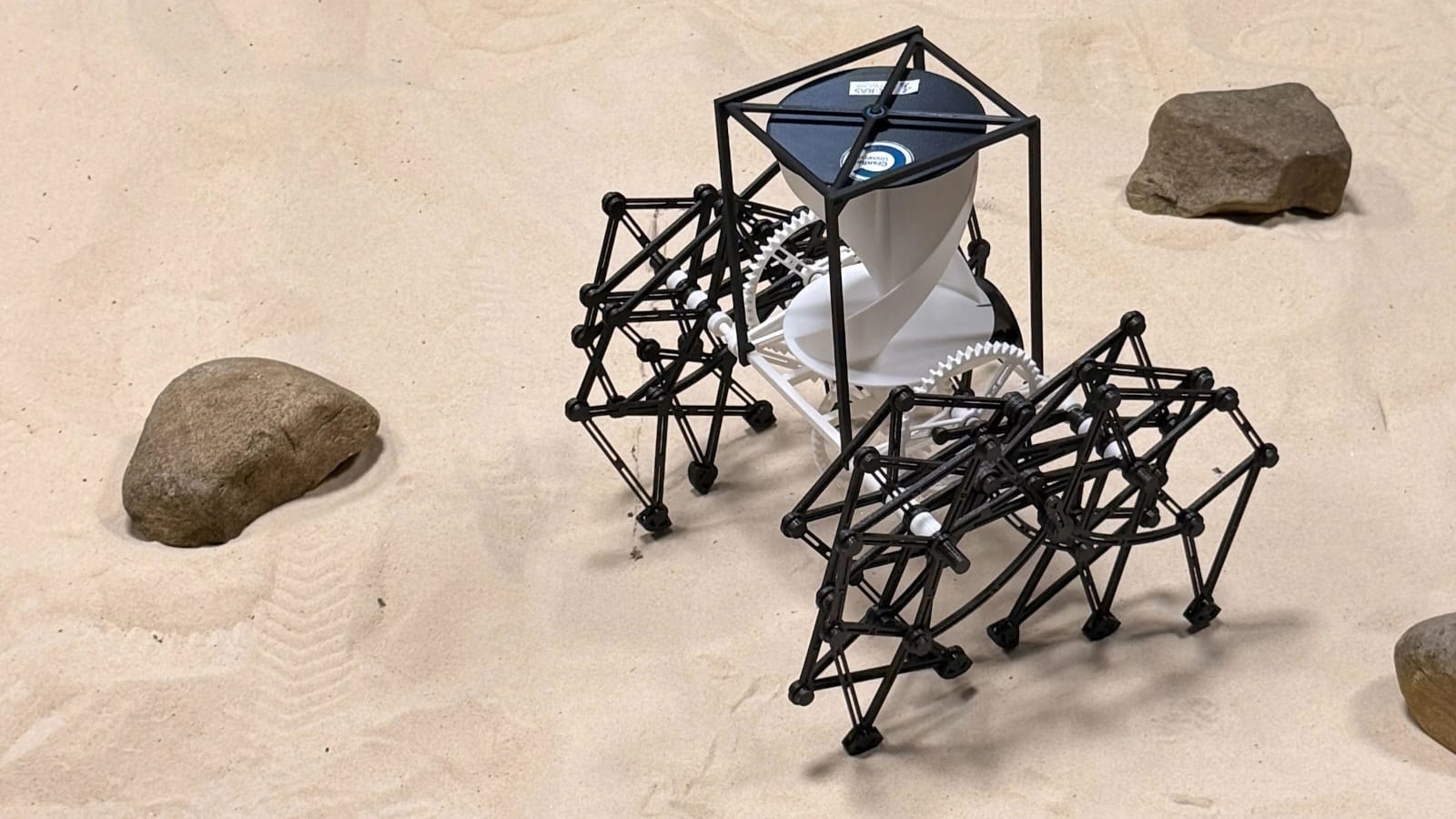
Researchers from Cranfield University have developed a unique robot capable of movement solely through harnessing wind energy. The robot, named WANDER-bot, is designed to explore extreme environments without requiring batteries whatsoever.
This innovation is noteworthy because most modern robots are heavily dependent on electrical power sources. In extreme conditions such as remote deserts, polar regions, or even other planets, battery limitations often present a major obstacle for exploration robots. Limited battery capacity forces robots to stop for recharging or cease operations entirely when energy is depleted.
WANDER-bot attempts to solve this problem through a simpler approach by utilising naturally available energy—wind.
Rather than using battery-powered electric motors, WANDER-bot employs a small wind turbine to power its mechanical system. When wind blows, the turbine rotates and converts wind energy into mechanical movement that drives the robot’s legs.
The robot utilises a mechanical system inspired by Dutch artist Theo Jansen’s work, specifically the leg structure found in the kinetic installation “Strandbeest”. This mechanism, known as Jansen linkage, is a series of mechanical rods that enable objects to walk with a stable gait pattern even when powered by a simple system.
With this design, the robot can continue moving as long as there is sufficient wind. This means the robot does not need to stop to recharge like conventional robots.
One of the most compelling aspects of WANDER-bot is its manufacturing method. Almost all robot components are produced using 3D printing technology.
This approach simplifies production and is relatively inexpensive compared to conventional exploration robots, which typically require complex components. Additionally, 3D printing technology opens the possibility of producing spare parts directly on-site if a component becomes damaged.
For long-distance exploration missions, particularly in space, the ability to print components directly could be a major advantage by reducing logistics requirements from Earth.
Researchers view robots like WANDER-bot as an early-stage concept for a new generation of exploration robots. Robots capable of harnessing environmental energy have the potential to operate longer than battery-based robots.
This concept is of interest to space agencies such as the European Space Agency, which continuously seeks sustainable exploration technology for future missions.
If this technology continues to develop, wind-powered robots could be deployed to explore regions difficult for humans to access, from vast deserts to the surfaces of other planets with extreme conditions.
Currently, WANDER-bot remains in early prototype stage and is being tested to determine its movement capabilities under various wind conditions. However, this battery-free robot concept opens new possibilities in the world of exploration robotics.
The simple approach of harnessing natural energy demonstrates that the future of robotics does not necessarily depend on large batteries or complex energy systems. In some cases, wind alone is sufficient to keep a machine moving.