
Will Fuel Prices Rise Due to US-Iran War? This Is What Airlangga Says
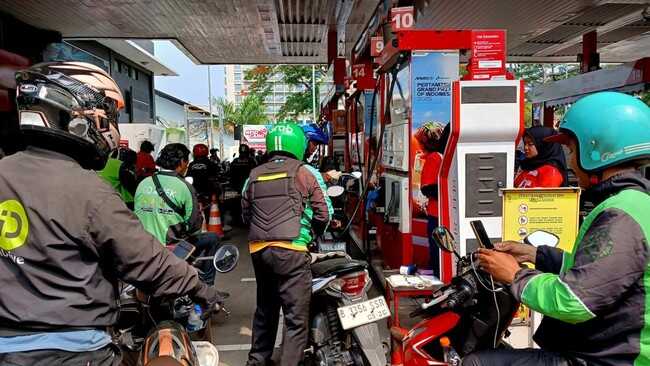
Jakarta – The Indonesian government has warned that fuel prices may rise as a consequence of the US-Israel conflict with Iran that erupted last weekend.
The conflict in a region that is a major global crude oil producer has affected energy prices. Global crude oil prices have recorded significant increases.
Coordinating Minister for Economic Affairs Airlangga Hartarto stated that as a country with the status of a net crude oil importer, fluctuations in global oil prices will directly affect domestic fuel prices. “It will automatically rise, just as it did during the Ukraine war,” Airlangga said at his office in Jakarta on Monday (2 March 2026).
However, Airlangga assured that fuel prices in Indonesia will not experience significant increases in the near term, as the global crude oil supply remains adequate. “But this time, supply from America will also increase and OPEC is also increasing its capacity,” he said. “So we’ll monitor it first,” he added.
According to Refinitiv data on Monday (2 March 2026) at 10:00 WIB, Brent oil price stood at $76.43 per barrel, whilst WTI was at $70.05 per barrel. This reflects a significant increase compared to Friday’s close (27 February 2026) when Brent was at $72.48 per barrel and WTI at $67.02 per barrel.
According to experts, this price increase is likely to continue given that Iran has decided to close one of the world’s major trade routes, the Strait of Hormuz.
Bhima Yudhistira, Executive Director of the Centre for Economic and Law Studies (CELIOS), projects global crude oil prices could reach $100 to $120 per barrel. “The disruption of the Strait of Hormuz will affect 20 per cent of global oil supply,” Bhima told CNBC Indonesia on Monday (2 March 2026).
According to Bhima, the situation has been exacerbated by increased security risks in the conflict zone, including refusal of insurance applications for logistics vessels transiting the area. This could hamper distribution and complicate oil import processes for many countries, including Indonesia.
As a net oil importer, Indonesia will face significant fiscal consequences. In the 2026 state budget simulation, every $1 increase in oil prices above budget assumptions can add approximately 10.3 trillion rupiah to state expenditure. This means if oil prices reach $100 to $120 per barrel, state expenditure could increase by up to 515 trillion rupiah in 2026, not just from fuel subsidies, but also compensation to Pertamina and electricity subsidies.
“There is a direct dual burden to the state budget. The situation is worsened by concerns over flight to quality from investors causing rupiah weakness,” Bhima said. He also noted that the food sector is vulnerable to impacts, particularly items sensitive to currency fluctuations and supply chain disruptions, such as soya beans, wheat, and meat. Imported inflation from oil and food will create a downward spiral in purchasing power.
“The public is clearly not prepared for fuel prices and volatile food inflation to surge excessively. If the conflict continues and expands, many developing countries could fall into economic crisis,” he said.
Separately, oil and gas practitioner Hadi Ismoyo, also Director of PT Petrogas Jatim Utama Cendana (PJUC), considered the latest Middle East conflict far more serious than previous tensions. According to him, the death of Iran’s Supreme Leader Ayatollah Ali Khamenei marks a turning point for escalating tensions, including the closure of the Strait of Hormuz. “This means 20 per cent of global oil supply will be lost, and 30 per cent of global LNG supply will disappear from the market. Oil and LNG commodity prices will rise significantly,” he said.
He projects conditions will deteriorate further given that Imam Khamenei was not only the Supreme Leader determining strategic policy, but also the Supreme Leader of the Twelver Shia clergy deeply revered by followers.