
Why Has Wall Street Succumbed to the Iran Conflict Despite Winning Various Wars?
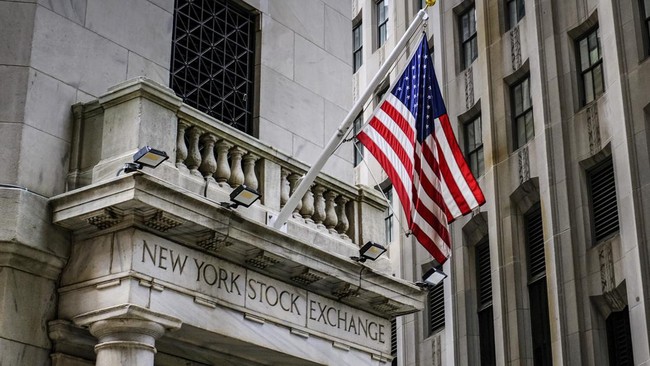
Jakarta, CNBC Indonesia — Global geopolitical tensions and military escalation between nations often serve as key factors triggering concerns and massive sell-offs among capital market participants.
Following the outbreak of the conflict on 28 February 2026 in Iran, the global stock market has responded to these dynamics with volatile movements, including Indonesia’s capital market.
The Resilience of the S&P 500 Index
The S&P 500 index, which serves as the primary benchmark for the United States stock market and a global barometer, has recorded a fairly significant drawdown. From Monday (2 March 2026) through yesterday, Tuesday (10 March 2026), the index has weakened approximately 3.15 per cent.
This decline reflects investor caution in the face of ongoing geopolitical uncertainty, which can trigger rises in global commodity prices and potentially increase inflation across the board. Psychologically, both institutional and retail investors tend to relocate their investment portfolios towards safe-haven instruments during the early stages of a crisis.
An in-depth review of historical data since 1979 actually demonstrates that the S&P 500 has consistently demonstrated resilience and recovery capabilities. However, a different story has unfolded this year amid the Iran versus Israel-US conflict.
Since Iraq’s invasion of Kuwait in 2003, Wall Street has always strengthened within a week of the conflict. This contrasts with this year, where Wall Street has collapsed following the Iran war.
The turmoil from the conflict between Iran, Israel, and the United States has directly shaken global stock markets, including Wall Street. Major indices such as the Dow Jones, S&P 500, and Nasdaq are typically pressured when geopolitical tensions escalate.
One key trigger is the surge in oil prices. The conflict involving Iran has sparked concerns about disruptions to global energy supplies, particularly if strategic routes such as the Strait of Hormuz are affected. Approximately 20 per cent of global oil trade passes through this route.
Rising oil prices increase production costs, trigger inflation, and compress company profits, prompting investors to divest shares.
As is known, oil prices surged to US$119 on Monday (9 March 2026), the highest level since June 2022.
Markets are also concerned that the conflict could escalate into a larger regional war. Should this occur, global trade, supply chains, and international transportation could potentially be disrupted.
On the other hand, surging energy prices could also drive inflation, meaning the Federal Reserve may maintain higher interest rates for longer. This condition is typically unfavourable for stock markets, particularly the technology sector.
Based on quantitative data, the impact of a conflict outbreak on stock markets is generally temporary and rarely disrupts long-term growth trends. Below is a summary of S&P 500 percentage movements from the commencement of various global conflicts:
Limited Volatility in the Early Crisis Phase
Referring to the historical metrics above, the S&P 500 index movement following the eruption of the conflict shows fluctuating yet moderately measured results. For the current Iran conflict, the index recorded a correction of -2.02 per cent in the first week of trading.
More significant negative reactions occurred during Iraq’s invasion of Kuwait in August 1990, or the Gulf War, where the index weakened -4.4 per cent in the first week and corrected further to -9.3 per cent in the first month.
This was heavily influenced by the global oil supply shock that triggered drastic energy price surges at that time, directly threatening corporate profit margins.
Conversely, in some modern cases, markets have not recorded meaningful corrections. This indicates that initial market panic is often driven more by short-term uncertainty sentiment than by genuine changes in fundamental economics.
Dominance of Macroeconomic Factors Over the Long Term
Market performance trends demonstrate a far more directional and stable pattern when observed over a 12-month period following the onset of a conflict.
From eight major events recorded in modern history, six successfully generated positive returns within one year. The Gaza War conflict (October 2023) recorded the highest gains with S&P 500 growth of 32.2 per cent.
Sharp declines actually occurred during the US invasion of Afghanistan (2001) with a correction of -26.7 per cent over 12 months. However, upon closer examination, this decline was fundamentally driven by the dot-com bubble and economic recession that suppressed US stock valuations, rather than solely from the impact of the military invasion.
Similarly, the -6.1 per cent decline following Russia’s invasion of Ukraine (2022) chronologically coincided with the Federal Reserve’s monetary policy tightening cycle.
Focus on Fundamentals and Valuation
Examining the historical data, history confirms one crucial principle in capital market dynamics: geopolitical conflict events very rarely serve as a singular catalyst that fundamentally shifts long-term trends.
Market attention ultimately always returns to focus on issuers’ earnings growth prospects, market liquidity availability, and central bank interest rate policy direction in responding to existing events.
These fundamental conditions have proven to exert far more dominant influence in shaping equity index valuation and movements compared to temporary fluctuations caused by geopolitical sentiment.