
Why Doesn't the KRL Green Line Use 12-Car Formations? Here's the Answer
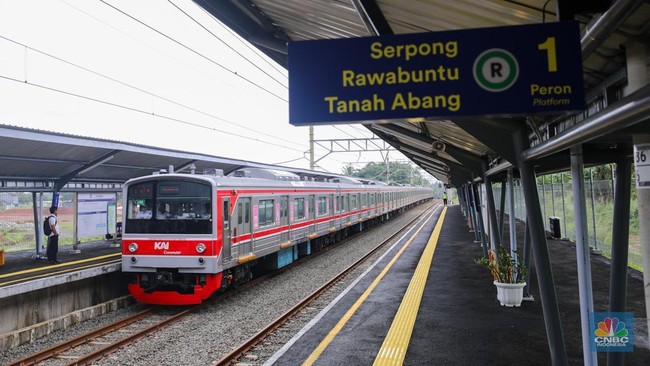
Jakarta, CNBC Indonesia - Not only do regular passengers complain about the increasing density on the KRL Commuter Line between Tanah Abang and Rangkasbitung, but they also lament the fleet of trains deemed very old, which affects journeys on that route.
These ageing KRL trains often make the air conditioning inside uncomfortable for passengers. When trains are very crowded, passengers become even more uncomfortable due to poor air quality inside the KRL. In fact, some fleets operating on that route rely only on air conditioning and fans.
One such complaint was voiced by Syami, a daily KRL user on that route, who noted that passenger numbers are rising, yet the operating trains still use a 10-car formation (SF 10). However, this route is quite long, with full journeys taking over two hours, even in normal conditions and not during peak hours.
“On weekdays, in the morning, how are people supposed to board? For example, if the first train arrives at a certain station, it’s already full, so people wanting to get on can’t, it’s packed. If they try the next one, it’s the same because the headway isn’t tight, so after several trains pass, only then can they board on the umpteenth one,” Syami told CNBC Indonesia on Friday (27/3/2026).
He even feels envious of other routes, especially Bekasi and Bogor, which already use many SF 12 formations. Not only that, those two routes also employ new KRL trains.
“I’m a bit envious, this route is one of the longest, and it has one of the highest passenger volumes, but it’s still served by 10 cars. Meanwhile, Bekasi or Cikarang is only about an hour, but they already have many 12-car formations. Bogor still has some 8-car ones, but many are now 12-car,” he continued.
Echoing Syami, Okta, another regular passenger, admitted that limited capacity makes it hard for many passengers to board, especially at Jurangmangu Station, where she boards the KRL.
“Mercy, on weekday mornings from Jurangmangu to Tanah Abang, it takes 2 to 3 KRLs passing by before I can board, and even then it’s still packed inside. Experience boarding KRL between 07:00-08:00 WIB,” said Okta.
She hopes the KRL capacity can be increased by operating SF 12 KRLs on that route. Additionally, she hopes infrastructure can be improved, such as signalling, increasing electrical power, and converting level crossings to non-level ones like flyovers or underpasses.
“Hopefully, upgrade the signalling so the headway can be tighter like on the Bogor route, then increase the electrical power, followed by operating SF 12 KRLs, and finally build non-level crossings (flyover/underpass) at crossings with high vehicle volumes,” she added.
Meanwhile, Noval, another regular user boarding from Sudimara Station, said queues of passengers wanting to enter the KRL can reach 4-5 rows during peak hours around 07:00 to 08:00 WIB. This indicates passengers can only board on the third subsequent train and must wait more than 15 minutes.
“Indeed, on a daily basis, especially boarding from Sudimara, it’s a squeeze and being squeezed to get in. If you can’t get in, the queue on the platform can be 4-5 rows deep, you can imagine,” said Noval.
Like other regular passengers on the Tanah Abang-Rangkasbitung KRL, he hopes the train capacity can be further increased by operating SF 12 KRLs.
“Yes, increase the electrical capacity so SF 12 KRLs can operate, also replace the signalling with open block, so the following KRL doesn’t have to wait far behind the one in front,” he explained.
In response to these complaints, PT KAI Commuter has actually trialled SF 12 KRLs on the Rangkasbitung line several times. Corporate Secretary Vice President of KAI Commuter, Karina Amanda, revealed that they trialled SF 12 KRL using the JR 205 series on 28 February 2026. This trial was conducted to assess reliability and challenges on the route.
“Not long ago, KAI Commuter conducted a trial run of KRL with SF 12 on the Rangkasbitung line as part of our commitment to increase train capacity,” Karina told CNBC Indonesia.
Unfortunately, KAI Commuter cannot yet operate those KRLs on the Tanah Abang-Rangkasbitung route due to several reasons, one of which is that the substation capacity to supply electricity to the overhead catenary system (LAA) is still insufficient.
“Infrastructure capacity constraints, namely the overhead catenary electrical power (LAA) and platforms that cannot yet accommodate SF 12 KRL, are also reasons why operations are not yet optimal,” she added.
This is also what prevents new KRLs from operating on that route. Moreover, new KRLs use SF 12 and require substantial electrical power to operate.
“Because it adjusts to the service infrastructure conditions on that line, one of which is the overhead catenary electrical power and platform lengths that not all can serve SF 12 KRL,” she explained.
Currently, new KRLs are operating with 16 trainsets on the Jakarta Kota-Bogor and Bekasi/Cikarang-Kampung Bandan routes. The details of those operating are 11 new KRL trainsets from China and 5 new KRL trainsets made by PT INKA (Persero).
KAI Commuter is also continuously working to update the infrastructure on that route, so that headway and KRL capacity can increase and reduce passenger build-up.
“In addition, by maintaining tight headways during peak hours, we are continuously coordinating with the government and KAI for its development,” she concluded.
For information, on the Tanah Abang-Rangkasbitung route, KAI Commuter has added two extra trips, bringing the total to 206 trips, up from 204 trips in 2025.
“We have added 2 extra trips during peak hours, previously 204 trips in 2025, now 206 trips.”