
WHO Recognition Boosts Trust in Indonesian Pharmaceutical Products Globally
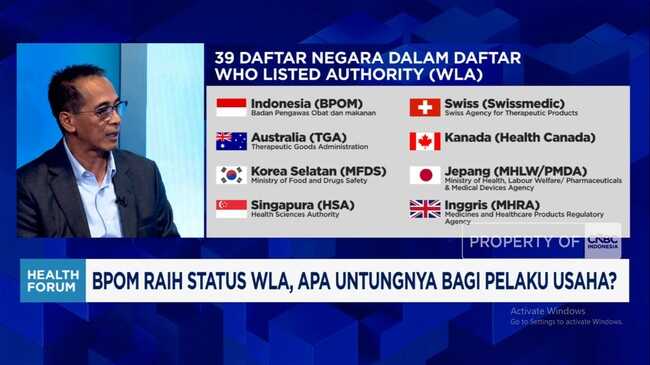
Jakarta, CNBC Indonesia — Shadiq Akasya, Chief Executive Officer of Bio Farma, has stated that WHO Listed Authority (WLA) recognition is a source of pride for Indonesia. The WLA serves as proof of equivalence that ensures Indonesian pharmaceutical quality is recognised internationally.
“WLA can accelerate Bio Farma’s growth. Beyond our existing products, future developments and exports will be facilitated more easily. This is not merely a business matter; it signifies an ecosystem where Indonesian products are accepted in other countries,” he emphasised during the CNBC Indonesia Health Forum on Sunday (28 February 2026).
The WLA status also provides efficiency benefits, as future WHO inspections will require only document submissions. Akasya hopes the WLA will help Indonesia achieve healthcare independence across both upstream and downstream sectors.
Akasya outlined that Indonesia requires greater effort in the upstream sector, whilst downstream operations like Bio Farma already produce 20 antigens and export to 150 countries worldwide.
“The WLA is particularly attractive because products will be more trusted—at premium prices. With WLA, our standards become more accessible as they align with international requirements. This may further strengthen upstream development,” Akasya explained.
Bio Farma currently exports medicines and vaccines representing 54% of its output, with immunisation products tailored to individual country requirements.
According to Akasya, WLA status opens further business opportunities for new product development. He believes that following WLA accreditation, partner nations will have greater confidence in Indonesia, not just for processes but also for clinical trials—positioning facilities like Bio Farma’s as competent hubs.
“For clinical trials beyond new products, we hope the Food and Drug Administration will conduct roadshows in those countries to showcase Indonesian products. Three companies could collectively address global requirements—from preclinical research to clinical trials—with WLA support,” Akasya stated.
Akasya identified Nigeria and Pakistan as promising markets, given their high birth rates.